

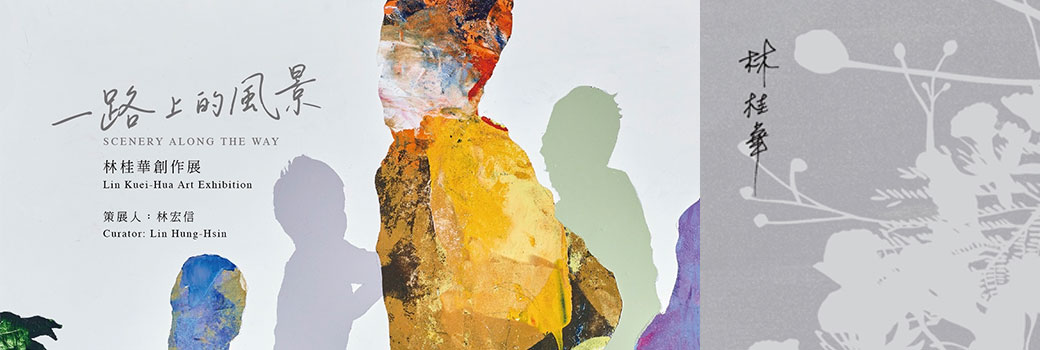
THE SCENERY ALONG THE WAY
◎ Duration:November 3 (Tue), 2026 – January 3 (Sun), 2027
Location:National Taiwan University Hospital Yunlin Branch, Huwei Campus, 2F Art Gallery
Address:No. 95, Xuefu Rd., Huwei Township, Yunlin County 632, Taiwan
Lin Kuei-Hua Art Exhibition
Lin Kuei-Hua’s artistic practice is closely intertwined with her personal life experiences. She draws inspiration from family memories, everyday life, and scenes encountered along her journeys, observing the world with a sensitive yet detached perspective. Through techniques such as flattened figures, negative space, layered imagery, scraping, and dripping, her work has gradually evolved into an exploration of the human figure, color, composition, and the very nature of painting. As she moves through different stages of life, she has become increasingly attentive to subtle moments in the everyday, using painting to revisit and reorganize memories, emotions, and interpersonal relationships, creating distinctive scenes that mark each step along her own artistic journey.

Kuei-Hua Lin – Let’s Have a Fight, OK ?


◎ Duration:September 6 (Sat), 2025 – October 4 (Sat), 2025
◎ Opening Reception: Saturday, September 6, 2025, 6–8 PM
Location:Thomas VanDyke Gallery
Address:434 39th St, Brooklyn, NY 11232
Kuei-Hua Lin’s New York Solo Debut
Thomas VanDyke Gallery is pleased to present Let’s Have a Fight, OK?, the first New York solo exhibition by Taiwanese artist Kuei-Hua Lin.
Known for her vibrant use of color, layered techniques, and deeply personal subject matter, Lin’s work moves fluidly between intimate memory and social observation. This exhibition highlights recent series that span from playful childhood scenes to urgent reflections on democracy, freedom, and collective identity.
Statement from the Artist
Fifteen years ago, I made a firm decision to change careers. I left the industry world and became a full-time painter.
Since childhood, I’ve always had a deep curiosity about the art world. Whenever I had the chance to visit art museums, exhibitions, or art fairs, I was often moved, sometimes even overwhelmed, by the beauty of the artworks I saw. In bookstores, I would linger in the art section the longest. I often found myself browsing around art supply shops, asking the staff questions like: “How do you use this pigment? This tool? This material?”
In the years leading up to my career shift, I took figure drawing courses at community colleges and art schools. At first, I taught myself: buying and reading books, studying color theory, experimenting with different paints, solvents, papers, and tools, and learning how to mount and frame works. I made many mediocre paintings and framed them myself, hanging them around the house to look at daily. As I gained more experience, I started identifying key issues in my work. Eventually, I realized I needed to break free from traditional approaches and develop my own spontaneous and intuitive techniques, something that would reflect a personal style I truly loved.
Starting in 2016, I fell in love with acrylic paint. Unlike oil paint, acrylic is water-soluble, odorless, easy to clean, and environmentally friendly. I also fell in love with the palette knife! Using knives of different shapes and sizes offers a wide range of possibilities and is quite intuitive. Mixing colors directly on the canvas with a knife preserves color purity and can create multi-layered effects with transparency and vividness.
Later, I discovered new ways of using silkscreen techniques that go beyond conventional methods. The combination of palette knife and silkscreen is, in my view, a perfect match. When paint is squeezed onto a screen and blended with a palette knife, it produces beautifully subtle gradients. Or, when a screen is placed on top of a painted surface and scraped over repeatedly with a knife, the resulting textures can vary from rough matte to mirror-like finishes, a contrast that creates a dynamic visual tension.
Contrast is one of the most important elements in my work; contrast in color, size, shape, brightness and shadow, line weight, and more. The more types of contrast a piece contains, the more vivid and engaging it becomes.


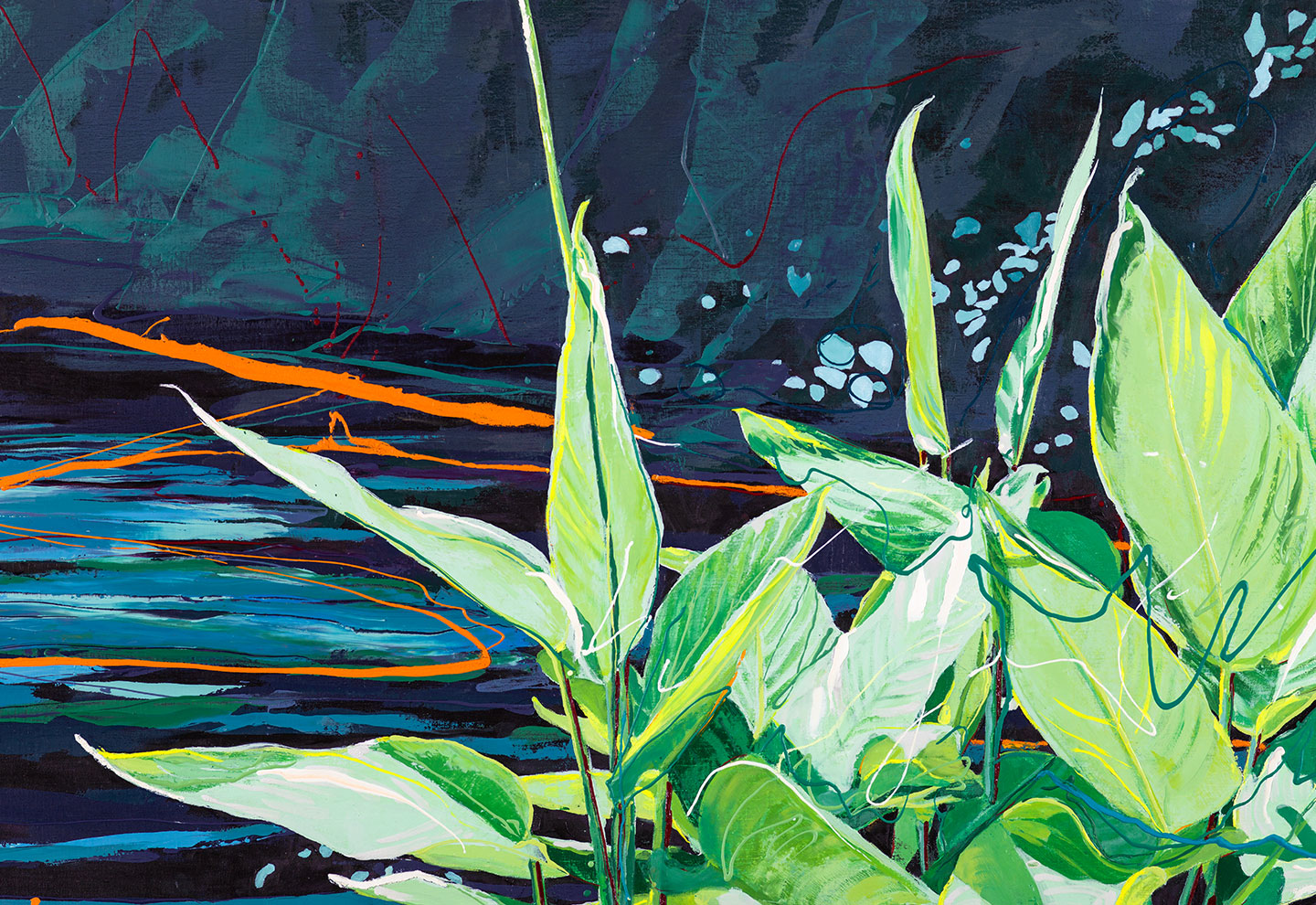
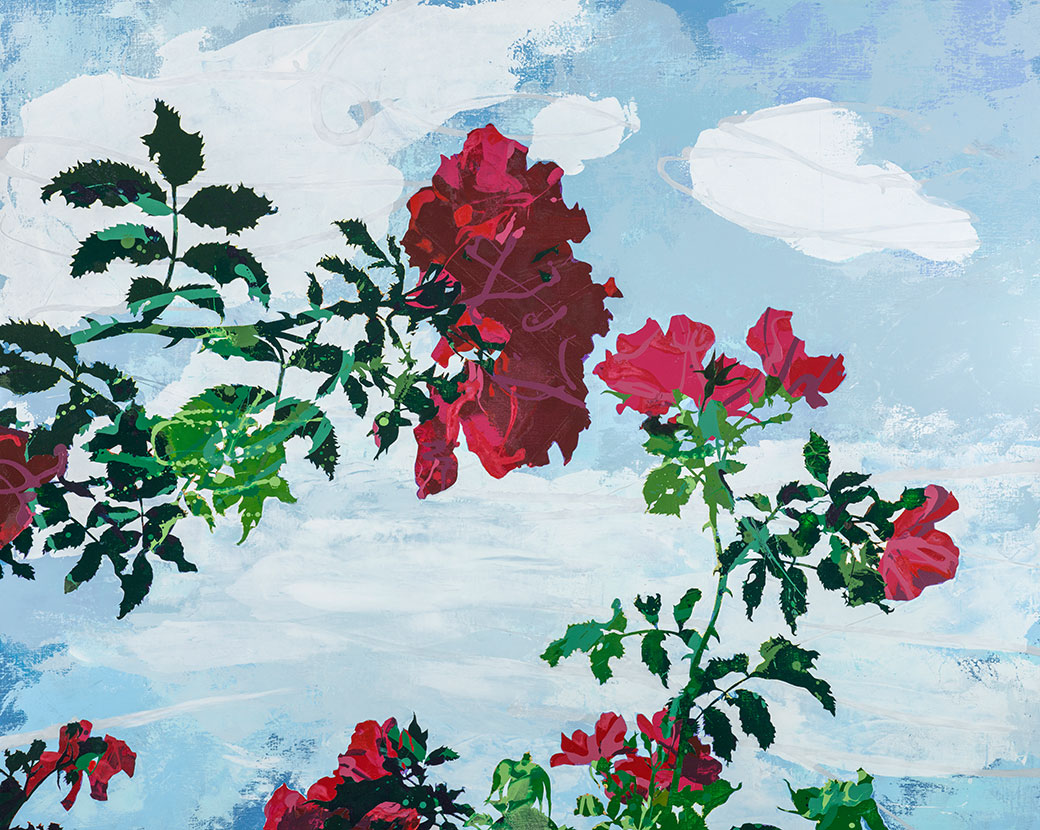
The themes of my work are often drawn from my own life. For example, my flower series was inspired by the flamboyant flame trees planted all over Taiwan. Every summer, the fiery red blossoms bloom high up on the trees. I would bring a light ladder to the trees, climb up with my camera to photograph the flowers, then return to my studio to enlarge the images and paint from them. Many people in Taiwan love the vivid red flowers of the flame tree. Interestingly, when they saw my paintings, they often asked what kind of flower it was, because normally one can only admire them from below, never up close or in detail.
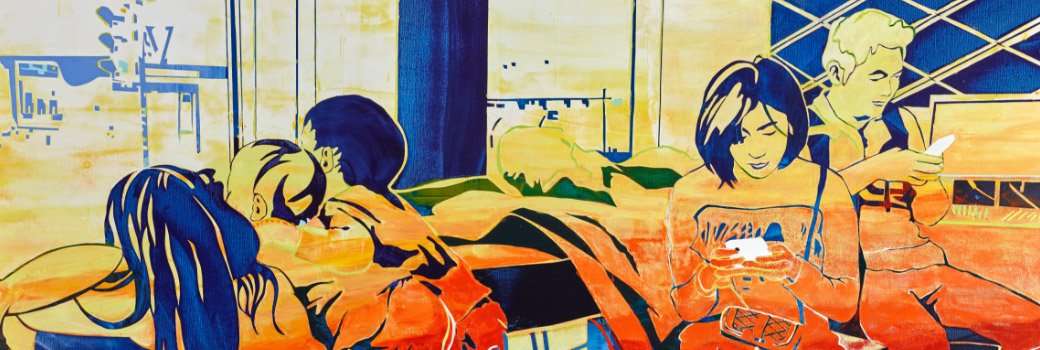
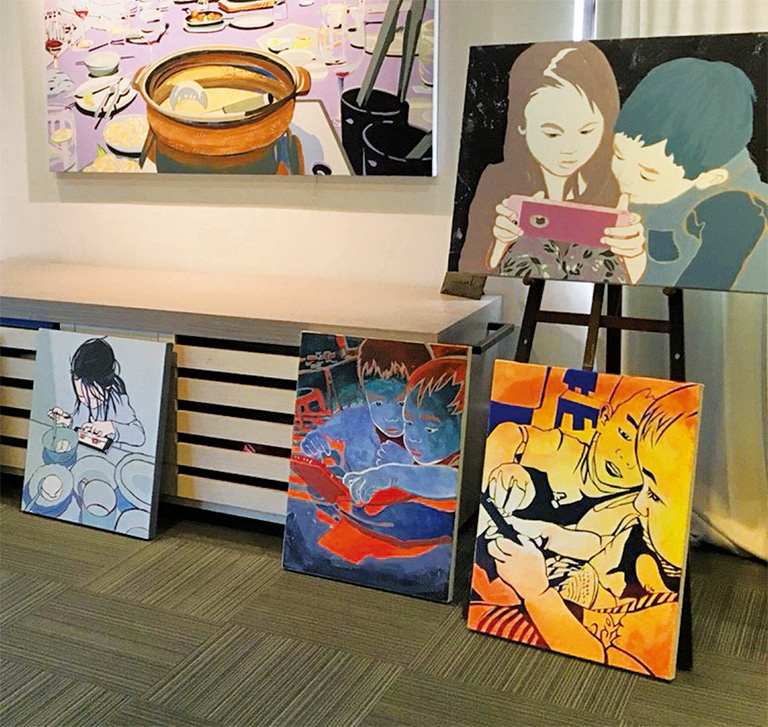
In my 3C Series, I depict modern society’s obsession with electronic devices (3C stands for Computer, Communication, and Consumer Electronics). No matter a person’s nationality, age, identity, or occupation, everyone is constantly on their phone. What’s most striking is how even toddlers who can’t read yet are captivated by these devices.
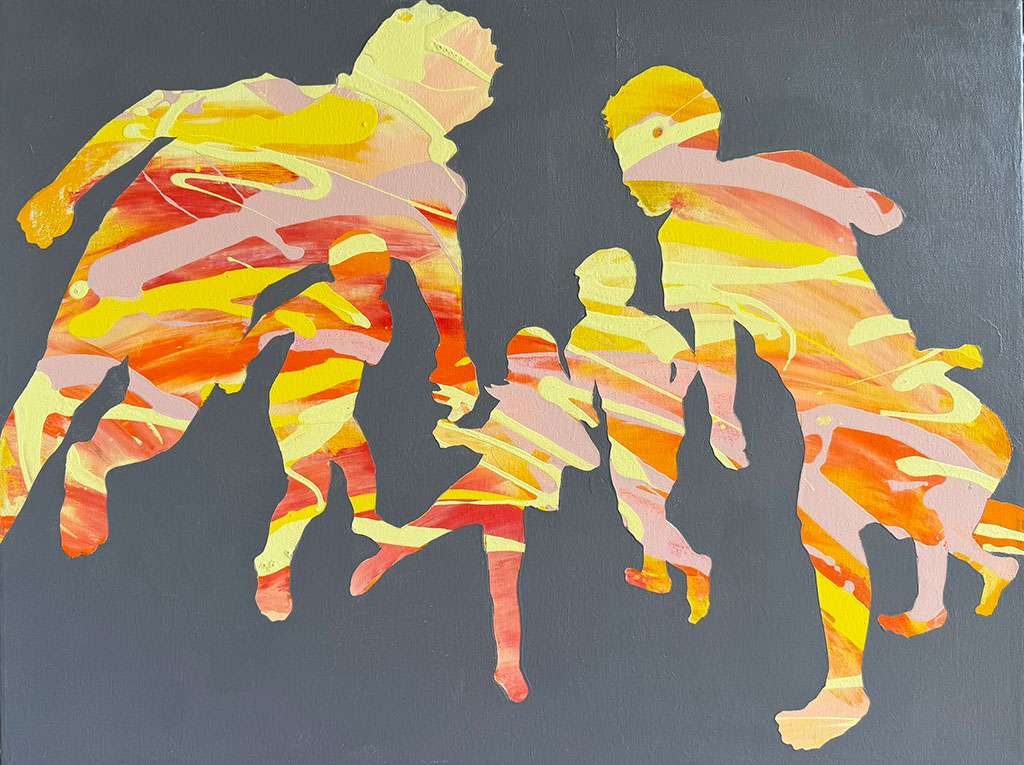
Another series, Fighting for Play, is inspired by my childhood. In the neighborhood where I grew up, lots of wild kids played in the alleys after school, and I was one of them. We caught dragonflies, played hide-and-seek, chased each other, roughhoused and laughed uncontrollably. That joy was unmatched. As an adult, I thought I’d never feel that kind of pure happiness again. But over the past ten years, four grandchildren were born. With them, I play tag, have pillow fights, pretend to wrestle, and laugh so hard it feels like we’ll burst through the ceiling! I created this series to preserve those moments.
In recent years, I’ve found myself drawn to subjects that reflect not just personal memory, but collective experience. As someone who has lived through Taiwan’s transformation from authoritarian rule to a vibrant democracy, I’ve witnessed firsthand how fragile and precious freedom can be. These lived experiences inevitably find their way into my creative work, especially as new threats to that freedom become harder to ignore.
Since martial law was lifted in 1987, Taiwan has gone through waves of protest and unrest. In 1996, the country held its first direct presidential election and began building a robust democratic system. Over time, the legislature matured, society stabilized, and the economy grew.
Currently, the Chinese government continues to falsely claim that Taiwan is part of its territory and has threatened to take the island by force. It wages disinformation campaigns, manipulates public opinion, and promotes pro-China, anti-democratic narratives. More alarmingly, it has exerted influence over local legislators, pushing policies that weaken Taiwan’s sovereignty. Violent confrontations in the legislative chamber, where some representatives block proceedings and physically brawl, have become disturbingly common. These scenes are not just political drama, they represent a real danger to the freedoms we’ve worked so hard to build. Watching this unfold, I felt compelled to document it through painting.
For me, painting has always been a way of paying close attention—to nature, to people, to joy, and to danger. Whether I’m capturing the overlooked beauty of a flower from above, the glow of a screen on a child’s face, or the chaos of political conflict, I paint to bear witness. Art allows me to hold both tenderness and urgency in the same frame. The act of creating; of mixing, layering, and contrasting; is also an act of questioning and caring. In this way, my work is not only personal but also inseparable from the world I live in.
— Lin Gui-Hua, July 14, 2025

Profile of Gallery Director and Curator
About Thomas Cornelius Van Dyke
Thomas Cornelius VanDyke is a respected gallerist and cultural figure whose career bridges the worlds of fine art, museum imaging, and contemporary exhibition design. After relocating to New York City in 2005, Van Dyke collaborated with influential artists and filmmakers including Michel Auder, Elizabeth Neal, and Gary Indiana. He went on to spend nearly 14 years at The Metropolitan Museum of Art, ultimately serving as Imaging Production Manager. There, he led major imaging initiatives in close partnership with curators, conservators, and scientists, contributing to some of the museum’s most complex and high-profile visual projects.
A dedicated student of photography from an early age, Van Dyke earned his BFA in Photography and Video from The Ohio State University, laying the foundation for a career distinguished by both technical expertise and curatorial vision. In 2019, Van Dyke joined David Zwirner, where he further honed his knowledge of the global gallery ecosystem. In 2022, he co-founded Thomas Van Dyke Gallery with his partner, Ivy. Located in Brooklyn, the gallery has quickly emerged as a vital force in contemporary art, acclaimed for its rigorous programming and strong commitment to supporting artists across disciplines and generations.

Curator, Li-Hsiang Huang
Li-Hsiang Huang is a curator, writer, and associate professor whose practice bridges visual and performing arts. With a career spanning the music industry, curatorial projects, art direction, and academia, she was awarded a Fulbright Visiting Scholarship in Performing Arts Administration (2021–2022) and is currently based in New York.
She began her career in classical music, serving as supervisor at Sony BMG Taiwan and collaborating with Yo-Yo Ma on multiple projects, including the Silk Road Project across three continents. Since initiating her curatorial career with an art event for Takashi Murakami, she has specialized in integrating performing and visual arts. As curator at the Glass Museum, her recent exhibitions received four international gold design awards in 2024.

2024 Shared Vision


◎ Duration:2024.6.7 ~ 7.7
◎ Opening:2024.6.7(五) 15:00
Location:Tainan Art Museum
Address:No. 37, Nanmen Rd., West Central Dist., Tainan City
Art Works


Our Collective Visual Experience ─ Insights into LIN Kuei-Hua’s Artistic Creation
by LIN Hung-Hsin
When you meet Lin Kuei-Hua today, you encounter an elegant lady with an air of efficiency about her. With more than 30 years of business experience behind her, she picked up paintbrushes and pivoted her pursuit to art, her long-hidden passion. During her business career, she was based in the United States for some time and used the opportunity to study painting at a community college. Years later, when business was stable and her children had grown up, Lin made the choice to unleash her suppressed desire for artistic expressions and threw herself wholeheartedly into painting. Although Lin’s present socioeconomic conditions may evoke that of la grande bourgeoisie post-industrial revolution, she most closely embodies a fervent new talent with insatiable thirst for experimentation.
Every now and then, when Lin recounts her childhood, she seems to adopt the perspective of an outsider, cooly observing her own family from a distance. She reflects on her father’s strict and serious demeanor, the traditional and conservative values in rural households, and the ostensibly family-above-all-else yet controlling and co-dependent reality of her traditional Taiwanese family. Lin confides that she felt like the odd one out, often overlooked and easily forgotten. However, it might have been this sense of detachment that sharpened her powers of observation and shaped her understanding of the world around her. Hide and Seek appears as testament to those years when she was often overlooked within her own household. Thinking that nobody would notice, she secluded herself inside the closet, quietly listening to the activities around her. However, her exposed feet served as proof of her existence. The extensive use of blank space, combined with sharp black lines, dominates a substantial portion of the canvas, challenging conventional rules of composition. The effect places an emphasis on the lowermost area of the painting, which delicately and emotionally depicts the scene. In The Adventurer, a child is backlit, rendering the facial features and body parts unrecognizable. This silhouette functions as a vessel for individual emotional projections. Golden light scatters across the canvas and through use of bold, scraped strokes, Lin skillfully breaks up the blue shades that represent shadow in the composition. In Graffiti, the innocent expressions of the two children are a mixture of fear and helplessness as they were caught in the act. These are moments that many of us have experienced in childhood. The scene is depicted in cool tones and harsh outlines while the contrasting free doodles on the wall, in concert with the floral linen, spring forward and take center stage. As the viewer moves his/her gaze from one element to the other, a dialogue commences. Lin seems to prefer flattening the figures’ physical attributes, thereby inviting projections on the part of the viewer. This enables free association of a personal narrative.
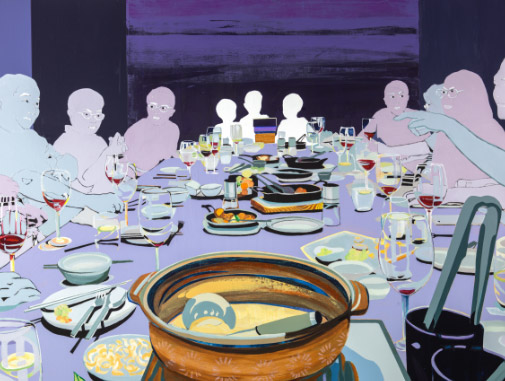
Perhaps due to her long years of operating a business, Lin maintains a busy social calendar. As a natural extension of her inclination to observe those around her, scenes of social interactions and interpersonal relationships became a significant element in her artwork. Over the years, Lin has transitioned from her business career to painting full-time. Her observations such as family life, everyday vignettes, and social happenings, provide source material for her work. Lin is exterior to the frame, observing the scenes through photo lenses. The work Snapshot faithfully portrays the dining habits of our digital age, where mobile phones have taken on the role of tasting foods. Social media is flushed with an overabundance of food photos, a part of the zeigeist of our time. In Time Tunnel, the focus lies on the empty plates and tableware post-consumption, a true representation of the merrymaking at dinner parties. Unlike many artworks that depict social interactions by emphasizing the interpersonal dynamics, Lin’s intentionally flattened figures are delegated to supporting roles within the composition. Other works such as Going to School, First Encounter, Father Feeding Baby, and Comfort etc., reveal the warm and sensitive side of the artist as she captures new experiences in different stages of life. By deliberately omitting certain details and utilizing simple, large color spaces with unified color schemes, the paintings exude a sense of calm, lending a window into the artist’s view from afar. The artist carefully maintains a distance, refraining from interfering in the lives of her subjects. Nevertheless, the limited facial expressions of the figures in the paintings inadvertently disclose their deepest emotions. Lin’s calm analysis is evident in the layers of paint in her artwork. The seemingly spontaneous splashes, scrapes, and layers are the result of swift mental calculations, constructed inside predetermined confines. It is controlled chaos. Lin’s technique involves repeat cutting and layering of transparent vinyl sheets to create stencils, to which paint is subsequently applied. Using syringes, scrapers, rollers, or knives, the paints produce an effect reminiscent of printmaking, setting it apart from the characteristic texture of paintbrushes. The use of transparent stencils allows for careful consideration of color combinations with the underlying layers, granting the artist the freedom of movement anchored in having a visible point of reference.
Upon closer examination of Lin’s works, in Roaming, Image II, Excitement, Focus, One and only, Come on, Graffiti and others, the figures are presented in a similar hollowed-out or negative space style. Does this suggest missing pieces of her own personal memories? The composition primarily features colorful backgrounds and vibrant screen images, drawing the attention of the figures inward as well as the viewer’s gaze. It seems as if the figures have receded from the frame, when in fact, they have not. Stepping back, one sees the larger blank spaces clash with high chromaticity of the background, where the blank spaces then assert their command over the attention of one’s visual experience. The figures do not exhibit excessive poses or body language, instead, they share a uniform posture of staring at the screen. Even young children are captivated, no wonder “phubber” becomes a label of contemporary society. The phenomenon of families and friends phubbing during gatherings has become a cultural spectacle, reminiscent of British artist Richard Hamilton’s 1956 collage piece Just what is it that makes today’s homes so different, so appealing? This artwork similarly depicts and explores how the mass adoption of new technology had brought about changes in people’s lifestyles. However, in contrast to the satire and caricatures of Pop Art, Lin herself participates in this change, observing everything from the perspective of a documentary photographer. She faithfully portrays the scenes and outlines silhouettes of those in her painting, using the photographs only as a foundation of the outer edges of the world. Typical photographic elements such as light, shadow, texture, colors, and figurativism are removed and replaced with the artist’s own choices. It is interesting to note that the sharp-edged contours created by the vinyl templates in Lin’s work recall a visual experience similar to Hamilton’s collages that juxtaposed images from cut print materials (eg. advertisements and magazines). Lin and Hamilton are two kindred spirits in their observations of human behavior and social phenomena, in their pursuit of the novel and the innovative, and in delivering impact on the viewers.
This series of works encompasses various aspects of Lin’s everyday life, including family life, social functions, random snapshots, and street observations. Without exception, figures in the paintings are deeply engrossed in the use of electronic devices, unable to divert their attention from their screens. Internet addiction has become a widespread issue in modern society. According to the “2019 General Survey on Digital of People with Mobile Phones” released by the National Communications Commission (NCC), the percentage of mobile phone users in Taiwan accessing the internet through their devices has steadily increased. It rose significantly from 35.3% in 2011 to 88.2% in 2018, and further climbed to 89.8% in 2019.1 The internet has become the primary source for acquiring information and entertainment in people’s daily lives. With the rise of self-media and social networking platforms, as well as the versatility and convenience of web portals, accessing information from various websites has become effortless. We can watch the same videos, view the same images, and share a collective visual experience, forging a common “vision.” Through mobile phones and the internet, it seems as though humans have reconstructed a modern-day “Tower of Babel,” establishing a shared language through collective visual experiences. In Lin’s artworks, the allure of visual windows is clearly presented. Using paint on canvas (or frame) as her medium, she captures her observations of contemporary life and social phenomena in the “window,” a surface that has been explored by countless artists throughout history. The layers of vibrant colors intertwine and shift, creating a visual tapestry reminiscent of the captivating hues encountered when facing a screen. It can be said that Lin has created yet another window, capturing the individuals immersed in their small screens. Meanwhile, the viewers who observe her artwork become another group of spectators, captivated by a larger screen that is the canvas.
The aforementioned works primarily arise from observing human social patterns within the context of infatuated internet use, social activities and everyday life around the artist. These artworks still maintain a measure of narrative quality and follow traditional principles of figurative painting. However, Lin’s new works in 2023 can be described as a full commitment to portraiture and, in the process, developing a unique creative vocabulary. They resemble meticulously planned and highly rehearsed feasts, with new artistic expressions refined through previous experimentations. In the Children Series and Play Series, Lin further zeros in on postures, isolating interpersonal dynamics and discarding all irrelevant backgrounds. The children’s figures engaged in play exhibit a sense of uninhibited freedom, distinct from the adults’ controlled movements that are shaped by years of social conditioning. The type of inhibited freedom on display may have arisen from hidden rebelliousness and the inner child’s sense of play. The body movements are seemingly sampled at random and reassembled. Through asymmetrical and whimsical rearrangement of proportions, Lin breaks with space and perspective principles. Traditional senses of lighting and space occupation by bodies is replaced by repeatedly scraped layering of colors, leaving only the silhouettes to dictate visual flow. Finally, a rational and evenly applied white background forms a negative space that establishes a perimeter within which free brushstrokes and spontaneous drippings may whirl, careen, and take flight. It is worth noting the bold use of metallic colors here, infusing grandeur without being out of place, a clear demonstration of the artist’s mastery with color. Abundant layering, flattened figures, and continuous movements in the artwork resemble intricate codes within the composition. The concept of “Figure-ground Illusion” is cleverly employed. By abandoning traditional figurative painting elements, the work comes closer to the exploration of painting itself. Through imagery, composition, brushstrokes, colors, textures, and more, the artist contemplates the essence of painting. This self-inquiry inevitably emerges as painting and/or artists reach beyond a certain stage of exploration in their artistic journey.
Through numerous conversations and following of Lin’s works over time, I have witnessed the distillation of her artistic vision as it evolved, as well as her joy in discovery of new frontiers. Most notably is Lin’s dedication to figurative painting. Every time I visited her studio, her undeniable enthusiasm is palpable, resembling a chef orchestrating a grand feast for the first time, presenting dish after dish that are vibrant in color, aroma, and taste. The highly prolific artist is remarkable in her boundless creative energy. Lin is constantly innovating, refusing to limit herself to past routines. For her, although repetition in expression is tedious and unbearable, Lin exemplifies the utmost discipline in her work ethics day in and day out. It is this unwavering commitment to her craft that defines the path that all artists must embrace.
2019 Survey on Digital Opportunities of People with Mobile Phones (Commissioned by: National Development Council; Conducted by: Union Marketing Research Co., Ltd. Republic of China, August 2019)


Creation Concept
Lin Kuei Hua
“Every morning, I feel a sense of anxiety and excitement, wanting to go to the studio, checking how the work I finished the day before turns out. Has the paint dried up yet? Are the colors accurate? The layers connect in the right way? What should I do afterwards? The anxiety repeatedly gives me the impulse, driving me to work.
“Is the topic strong enough? (Can I make adjustment in the next painting?) Should the flawed parts be improved? (Too perfect is might make people out of breath) How much should I keep to make it lively and interesting? Are the contrary elements enough? For example, straight and curved lines, fast and slow, color bocks, bright and dark, hue,…etc.. The more the contrary elements are, the livelier it becomes. There is no such thing as perfect in this world, only contradiction, conflict, and the co-existence of fortunate and unfortunate.
I like to go back to zero for the cognition of objects, and then restart, trying all the possibilities. When I paint a certain topic, I might go back to the traditional techniques. This repetition keeps my thoughts fresh, jumping out of the box to avoid self-duplication. “
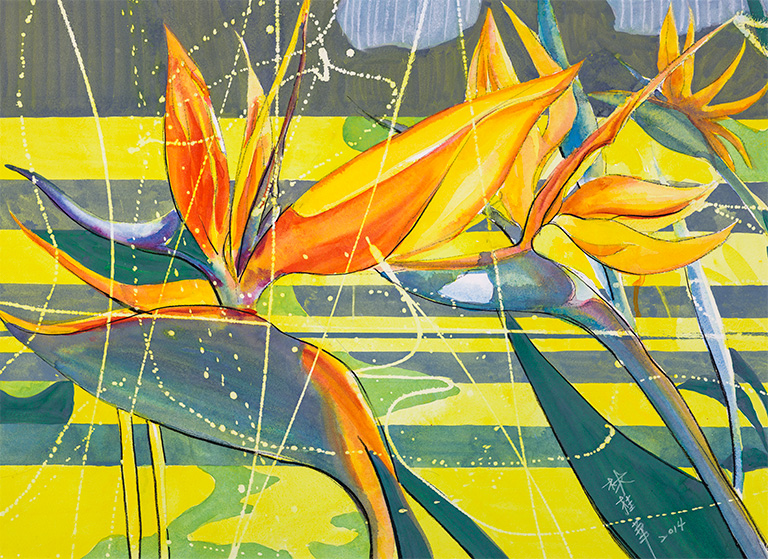
“Flowers are the production of nature. They are in free in form, shaking with breeze and presenting the most beautiful and natural form of activeness. The works in this series express the smoothness of lines and colors, narrating their existence in the nature.”
Gallery
Opening Ceremony
Guided Tours & Visits

Meeting Phoenix

◎ Duration:2022.07.01 ~ 09.30
◎ Opening:2022.07.02(六) 14:30
Location:Regent Hotel VIP Room Taipei Taiwan
地址:No. 3, Ln. 39, Sec. 2, Zhongshan N. Rd., Zhongshan Dist., Taipei City , Taiwan (R.O.C.)
Opening Venue & Exhibition Space
Virtual from the Window
◎ Duration:2019.04.27 ~ 05.26
◎ Opening:2019.04.27(六) 15:00
◎ Seminar:2019.05.04(六) 15:00
Location:Cloud Gallery ╱ www.cloud-gallery.org
Address:No. 469, Mingshui Rd., Zhongshan Dist., Taipei City 104, Taiwan (R.O.C.)
Opening hours:Tuesday to Sunday 10:00 ~ 18:30
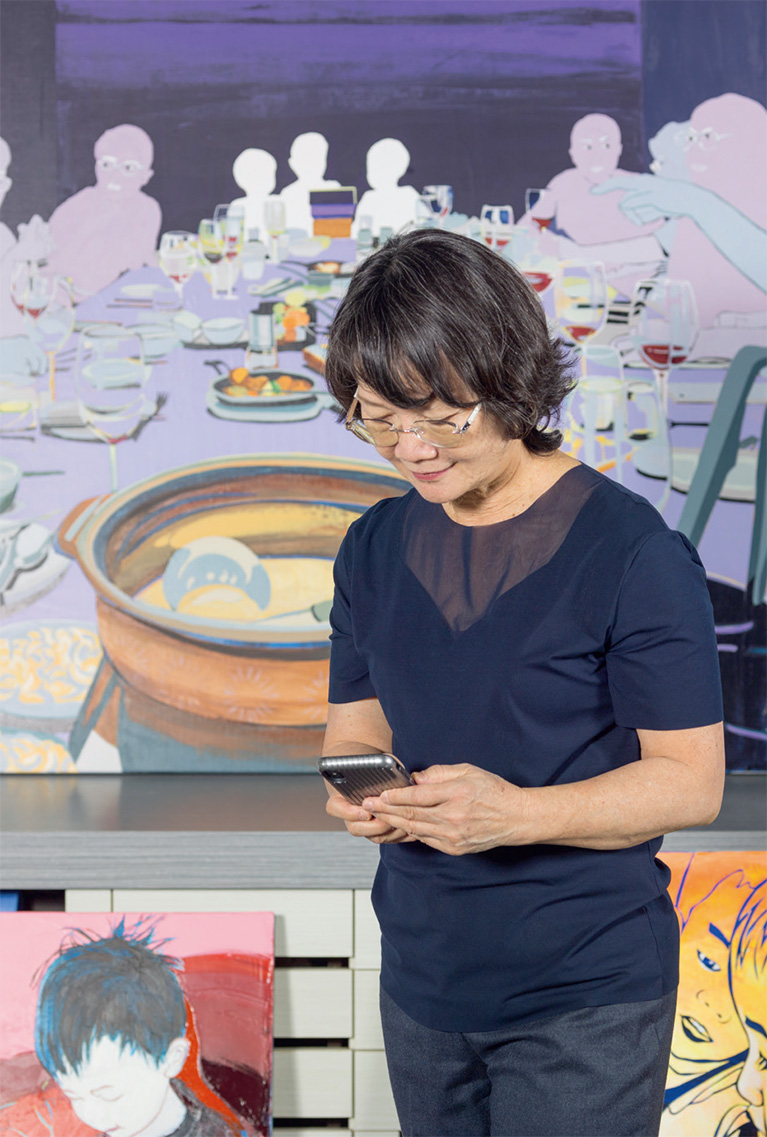
we present “Re-Visiting Virtual Window” as the topic of Lin’s sole exhibition, expressing the paintings, the frames, and the topic. Exhibited works include two topics: before 2017, which is mainly using plants, flowers as themes, such as Kite, Flowing Light and “Commencement”, etc… These works use acrylic colors, templates and syringe, to let the paints naturally cumulate, duplicate and cover on canvas, producing rich layers of paints. Another topic is after 2017, mainly focusing on people. However, instead of portrait paintings, she locates the figures in particular scenery, especially the people who are using mobile phones and tablets, with extending techniques.
– Curator╱Gary Lee
Creation Concept
Every morning, I feel a sense of anxiety and excitement, wanting to go to the studio, checking how the work I finished the day before turns out. Has the paint dried up yet? Are the colors accurate? The layers connect in the right way? What should I do afterwards? The anxiety repeatedly gives me the impulse, driving me to work.
Technology, life, creation and daily scenario
My father is a low-ranked government employee, with an income barely keeping a family of six. After work, he always got together with neighbors from the Taiwan Power Company, complaining about work. Sometimes he practiced calligraphy, plants orchids or takes pictures everywhere, as if a lost artist. So I knew how to use a camera at the age of five. I discussed with my father about aperture, photographic angle, composition, …etc.; this might be why I started to love technical products.
In 1980, Taiwan’s economy is turning better, Lin started working in international trade, spending a great amount of time typing typewriter processing business papers. When personal computers come out, due to efficiency improvement and curiosity toward technology, she started learning computer and coding. She was passionately all the way. Since year 2000, internet and mobile phone develop in light speed. People’s lives are inseparable with electronic devices and mobile phones. This phenomenon intrigued me and inspired me to paint about this topic. I also paint my daily life routines. The main theme of this exhibition originates from my background, life and work experience. For me, life is art and art is life.
The figures, characters in the paintings are mostly my friends. The children in the paintings, although cannot speak and read, can quickly find pictures and animation in their parents’ mobile phones. It is common to see crying babies would quiet down once they get in contact with mobile phones or iPads. This really shocks me. As they grow, these technical products influence in an unexpected way. It is no exception for grown-ups. No matter when or where, everyone always has a phone in hand, staring at the screen like there are no others. Some of them are thinking, some of them are exchanging information, some contacting others, some replying emails…etc.. There is one huge company CEO, who concentrates on his mobile phone working even when guests surrounding him are singing karaoke. I like to paint figures, even when they are in parties, I’d still remember their professional side. As I paint, I keep thinking the connection of human and technology in the future.
Construction, destruction, repetition and negotiation
The accomplishment of every work has to go through four turning points. At first, choose a topic, construct an image in my brain, and excitedly hope for it to come true. After fast drafting, coloring and polishing, a painting can be considered good. But the other me, who is less settled, would jump out and ask, how is this painting different from others? Is there anything special? Is it meaningful?
Then I would calm down and pack up my habitual casual logic and start to change. This change is either good or bad. Should I take the risk? Yes, there’s no other choice.
The unfortunate thing is that it usually goes bad; therefore pain is produced. There’s at least 10 days to half a month that I bear the endless anxiety. I cannot discard the painting because it goes bad, otherwise the next painting would face the same problem. In the unsettled and uncertain status, you have to keep trying to improve the image. In this process, sometimes I have to cogitate and sketch. Sometimes, I have to paint quickly without using my brain. It is surprising that inspiration always come in blindness and chaos. After these actions, I’d always encounter an amazingly good painting.
Finally, I would spend several days to sit in front of the finished work, think about what has happened, check every detail, and finish the last polish. Sometimes, I would paint another similar piece to make sure the technique used can be copied. That is why I usually have two similar pieces of work. I would paint more for fun.
When review, I need to consider many aspects, such as,
Is the topic strong enough? (Can I make adjustment in the next painting?) Should the flawed parts be improved? (Too perfect is might make people out of breath) How much should I keep to make it lively and interesting? Are the contrary elements enough? For example, straight and curved lines, fast and slow, color bocks, bright and dark, hue,…etc.. The more the contrary elements are, the livelier it becomes. There is no such thing as perfect in this world, only contradiction, conflict, and the co-existence of fortunate and unfortunate.
I like to go back to zero for the cognition of objects, and then restart, trying all the possibilities. When I paint a certain topic, I might go back to the traditional techniques. This repetition keeps my thoughts fresh, jumping out of the box to avoid self-duplication.
Execution in Creation: Do the deep, do the difficult, ponder when you do, do the easy
Art looks easy, but when you look at it closely, you get lost. I yearned to be a professional artist. Only when I am full time, putting all the effort it in, I can encounter professionals in the art industry and learning all aspects in art. I like to work, like to be with people who work hard. Only when you love your work, you can proceed when encountering obstacles and barriers.
“Don‘t think about making art, just get it done. Let everyone else decide if it’s good or bad. While they are deciding, make even more art。”
Through practice, I gradually understand the criteria to become a professional artist, and realize the challenge I might face. At the same time, this simulate more curiosity, what is truly art? As this phrase, I can only keep on creating. Just like the American Artist, Andy Warhol once said, ““Don‘t think about making art, just get it done. Let everyone else decide if it’s good or bad. While they are deciding, make even more art。”
Painterly Superimposition
◎ Duration:2016.09.10 ~ 10.15
◎ Opening:2016.09.10(六) 14:00
◎ Seminar:2016.09.24(六) 14:00
Location:See ART ╱ www.seeart.space
Address:No. 22, Ln. 60, Taishun St., Da’an Dist., Taipei City 106, Taiwan (R.O.C.)
Opening hours:Tuesday to Sunday 10:00 ~ 18:30
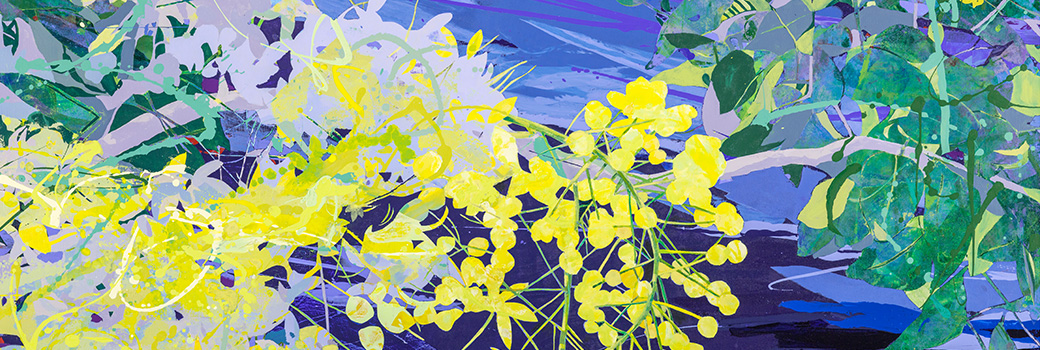
The drastic variation of human’s visual experiences caused by development of technology and changing lifestyle often influences the artistic expression we create. Consequently, artistic practice – or “the freedom of expression” as how we usually define it – celebrates not only the individual’s inner reaction but also the interrelation among one’s cultural experience, artistic context, the materiality of media, and the life journey of an individual. Similarly, the effects of three different visual experiences can be discovered in Kuei-Hua Lin’s works: first of all, the context of “painterliness” in the tradition of painting; secondly, the camera angle in photography; thirdly, the dislocation of printing or superimposition in the image-base art history.
To begin with, “painterliness” is a term commonly used in art history, opposite to the concept of linearity. Art historian Heinrich Wölfflin (1864-1945) has characterized the artistic transformation from Renaissance to Baroque as change of style from linearity to painterliness. According to him, linearity describes the clear and flat linear design popular in Renaissance art, while painterliness allow Baroque art to create a three-dimensional quality with curves, obscure contours, and a stronger chiaroscuro effect. The contrast somewhat summarizes the spectrum of Western art – the former is more classical and restrained while the latter is more emotional and expressive. In this respect, Lin”s art is close to the painterely concept. In her artmaking, she not only freedom of painting executed by her hand. Therefore, most of her previous works feature a greater spontaneity thanks to the flowing lines and dripping =effect of water-based pigments.
The second visual experience is related to photography. Her favorite composition is either an upward view or a close-up, a result of her habit of modeling photos of flora which she has taken in her journey. In fact, the increasing accessibility to photography has make it a tool in painting, but the real impact on the practice of painting is in its cultural and visual aspect that photography provides a new camera-based perspective beyond the traditional composition in painting. As a result, it is no longer required for painting to establish a well-developed storytelling scene but encourages it to focus on the fragmented, partial, instant, photographic image. Meanwhile, the detailed, close-up partial view further highlights the quality of painting as a form.
The third visual experience comes from the dislocation of printing and superimposition. Nowadays, we may feel familiar with these kinds of effects caused by printing errors, chromatic errors, photographic multiple exposure of intentional superimposition. Whether intentional or by mistake, the effects reveal the thin, flat, and accumulative quality of image itself. Examples can be found in the artmaking process of Lin’s recent works where she chooses various images of silhouette and makes them into several shaping plates, while she later applies layers of thick or thin acrylic paints on them. The direction of the strokes and shapes is often intersecting the shaping plate’s composition, crating three layers of images, including the one painted with the plate covering, with it half covering, and with it removes. The artmaking process reflects the thin-versus-thick relation between images and paints. With an intentional emphasis on its e=texture, it highlights a relief-like thickness variation between the part with plate covering and part without.
Lin’s artistic practice is inspired by her life. Simple subjects are her favorite, while the overall scene depiction in her earlier works is gradually replaced by partial views of flowers and fruits. Similar to Paul Cezanne (1839-1906)’s dedication to still life painting and Mont Sainte-Victoire, Lin also adopts simple scenes and objects to elaborate her exploration of shapes. Through the layers and artmaking procedure of her works, such as the techniques of emboss, fretwork, brushing, and reserving the background, we are invited into a dialogue between the layered painting and image itself.
– Curator╱Jian Liting
The Flower in the Wilderness:Kuei-Hua Lin’s Vision of Colors
Curator╱Wu Shu-An
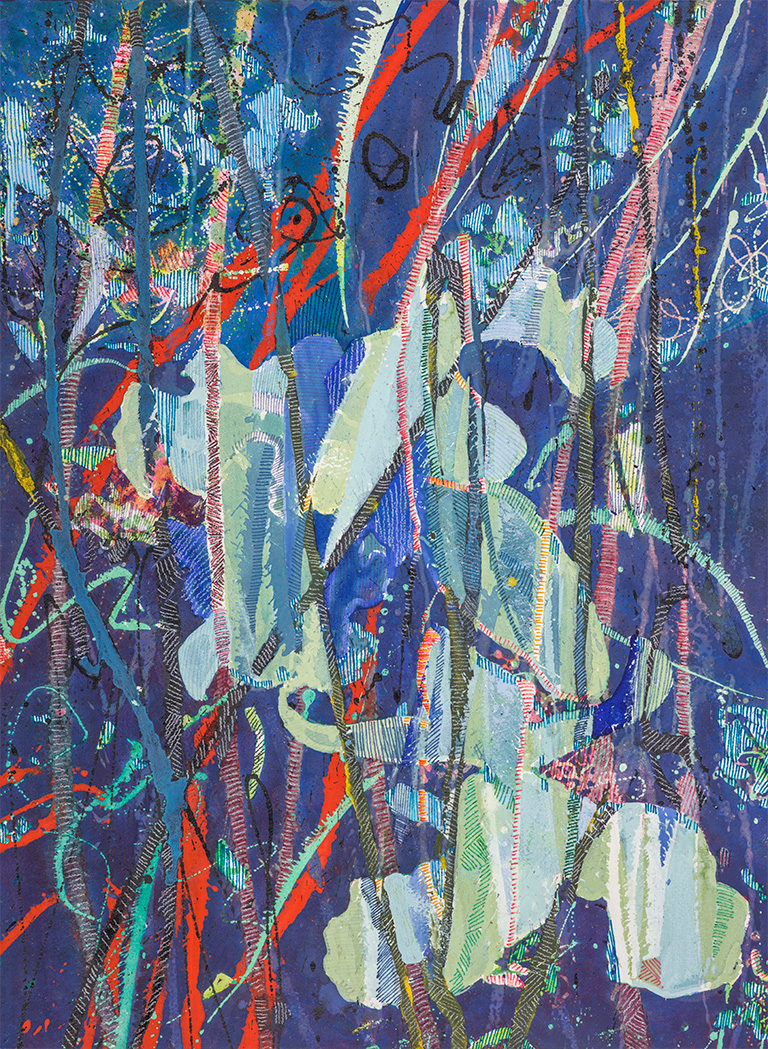
As thin and transparent as a cicada’s wing, the glaze base featured in Kuei-Hua’s composition is a vivid contrast to its strong and powerful subject, reminiscent of Ma Yuan and Shia Kuei’s “one-corner composition.” Polished like a jade, rough like a rock, stirred like bubbles – it is not only our first impression of Lin’s works but also the charm of them, a series of paintings finished with precision, intensity, contemporaneity, and clever subtlety.
Brush Walking: Eyes, Brain, Hands, and Heart
Although how we paint is always based on how we plan, Lin, like Gille Deleuze’s analysis Francis Bacon, begins with destroying any pre-established rules concerning the image itself and her own imagination, allowing her hand to lead the action. After rounds of adjustments, the work is finally completed. She seldom abandons what she has already finished. No one can imagine what she has been through and what measures she has taken throughout the whole artmaking process. For her, painting is her labor-intensive work. The days spent in her studio, where she takes advantage of the color spectrum of natural lighting, crystalize her labor into a precious gem. The great amount of water-based pigments used in her works such as watercolor or acrylic paint reveals her eagerness to express herself through art and to establish her signature. She also utilized a palette knife to scratch and flatten the base paint, making it a thin transparent membrane, on which the artist creates a layered plane of splendid visual intensity characterized with splash, script, and scrape. The subject of the paintings does not seem to be a priority to Lin, After all, it is quite impossible to find an untouched subject in the category of figurative painting. Therefore, Lin focused more on the techniques. She lets her eyes and hands to replace mind and brain. The paint’s spontaneous flow follows the movement of the hand, establishing a unique artistic style different from any painter before her.
Allowing the had to move before thought does not suggest that the artist reject any consciousness in painting. Instead, she lets the strokes and paint to stretch freely on the canvas, while the result of what they grow into is again polished and adjusted carefully by the artist. Lin’s paintings are complicated for that they have been through laps and twists. However, it is the only possible way for the artist to locate herself and to establish her artistic signature, just like those great painters before her.
Painting: The Layered Past
The reward of her technique-exploring is the surprising and unexpected artmaking process demonstrated on her works. Examples include needle splash, the use of palette knives, or the transformative and diverse textures crated on the dried flat acrylic maintaining a rich, solid, flowing, and organic visual quality. The simple elements are carefully arranged with Lin’s perfect subtlety, while the randomness is the interaction between consciousness and spontaneity. “Thought before strokes,” it is not to say that her works ack consciousness, but the random brush walking is the only way to fight against a tradition of painting which is heading toward its own end and to establish a unique artistic expression. Lin’s painting is lively and spontaneous while it is also rational and discreet. I am not suggesting the artist’s works are overwhelmed by contradictions, but the balance between the two helps achieve the most satisfying consequence – brisk but yet modest personality, highlighted with the strongest visual impression as her tour de force.
The artist often rejects the conventional practice of chiaroscuro. Instead, she utilizes a large scale of strong colors to visualize intensive shapes, creating a double-edged effect as the abstract expression captures the spirit of the object. In other words, we see the tree, and we also see the forest. She loves painting flowers and fruits, but she does not follow the traditional still-life composition which we have been familiar with. The partial view of the close-up makes the image more abstract, and the powerful contrast harmonized with nature is the most precious source, just like the natural breeze and light hidden beneath the sculpted layers.
A Brisk Breeze: The Waltz of Nature
Lin’s art is bright and precise, but the diverse potentialities also demonstrate her adventurous determination. She pursues the enchanting visual experience, while she also attempts to visualize a vigorousness in her paintings. The dominant portion of strong colors seems menacing, but you will soon find in it a perfect execution of subtle and rapid strokes if you take a closer look. The visual effect is sober and yet rich, like a lively waltz in the brisk breeze, revealing both the excitement and sweetness of flowers and fruits. The most distinguishable is the almost primitive vitality, the labor-intensive process of the painting gathering the effort of mind, hands, brain, and eyes. The artist believes that to begin with actions (“painting strokes” to be precise) is the only way to achieve originality. Such a trick rule she sets up for herself is how she avoids repetition and insipidity, while it also allows her to create a conflicting but yet balanced image.
The risk-taking journey to search for one’s uniqueness encourages the artist to keep exploring new styles and expressions every time when she finishes several paintings in a series. It is never easy quite challenging and risky indeed. However, Lin’s uncompromised artistic practice and dedication has made the adventure conquerable, replacing obstacles with a continuity of constant diversity. Here, we see a different Lin – a brave and fearless challenger that no threat of failure will stop her in this journey toward absolute originality. The painting brush silence our eyes, offering a moment of meditative serenity between viewers and paintings. Meanwhile, viewing becomes a pleasant experience for viewers to hit the road with the painter. Her artistic journey continues, as she rejects to give up her experiment and the attempt to make a breakthrough. We surely will wait for her to make a new turn, where we may be welcomed by a totally different vision, though derived from the same narrative – the style without a style, the determination to take challenges, the experimental techniques, and the surfacing to a wonderful vision.,

LINE。DARE TO LINE

◎ Duration:2013.10.12 ~ 10.17
◎ Reception:2016.10.12(六) 15:00 ~ 16:30
Location:THE-CHUN ART GALLERY DEPARTMENT OF FINE ARTS NATIONAL TAIWAN NORMAL UNIVERSITY
Address:No. 1, Shida Rd., Da’an Dist., Taipei City 106, Taiwan (R.O.C.)
Opening hours:Tuesday to Sunday 09:00 ~ 17:00


An artistic Originality: the Subtle Gaze into the Light-and-shadow of the Scenes
In 1995 when I was 42 years old, I moved to the sunny Southern California because of some health problem. One day, I received a program about adult education from Pasadena Community College and I saw that they offered a course “Life Drawing.” I thought that it was about still life drawing, so I registered for the class and paid the fee right away, hoping to learn some basic painting techniques. When the class began, the teacher gestured a female model to walk into the classroom and asked us to draw her. Suddenly, I saw her taking off clothes. What happened? It was so shocking. I did not even know where to look at. It turned out that “life drawing” was about human figure drawing! It was a lucky accident for me to walk into the world of painting!
Not only the year of 2006 did I start to liberate myself from the pre-existing conventions and to freely express myself. I have gradually found the main concept of my artistic practice – “lines.” In addition to the exploration of related materials and tools, I also focus on several concepts as mentioned below:
I. Techniques:
1. Watercolor paint: In order to highlight the strength, speed, direction, equaled width and other qualities of watercolor paint, I use needle tubes to paint. Since watercolor paint is easy to be mixed and dried while it also has high fluidity, I usually put the frequently-used colors in several jars, and use needle tubes to pump in, mixing the colors in the needle tubes. Then I use needle tube as brushes to paint on paper. Sometimes the paint is splashed on paper as if it were out of control, while sometimes the undried lines are added with different colors as if I were mixing colors on paper. These techniques indeed help create totally different strokes from using brushes.
2. Pastel paint: With its low transparency and fluidity, pastel paint is a wonderful material for drawing. I take advantage of its unique quality and different strokes in my still life drawing.
3. Oil paint: Oil paint is thicker and stickier. It is quite impossible to find a proper tool to smoothly paint the handwriting-like silky lines. Therefore, I mix paint thinner and oil paint in proper proportion, using needle tube to randomly squeeze the long lines. Such a method visualizes the realistic subjects in a more fluent and natural way. Sometimes I use less paint thinner to mix, creating a stronger three-dimensional quality. Before the lines are completely dried, I slide the palette on the lines horizontally to create smooth lines with equal thickness.
II. Lines: the Vocabulary of Tools/the Linear Texture
1. To master the linear essence of tools: Sometimes the painting material will create a totally opposite effect against its essence. Therefore, the first thing I do is always to understand the quality and the limitation of materials, regarding tools, techniques, and the lines as a whole. My exploration bases on my life experiences such as the ink-related ones (including marker, sign pen, fountain pen, and etc.), oil-related or powder-like ones such as charcoal, and crayons of various colors.
A new line-painting tool can help painters to challenge their old habit while it also forces them to use their hands in a different way. In other words, compared with the familiar and predictable tool one used to use, a new line-painting tool might come up with a different way to visualize the ideal painting.
2. The controlled lines and the out-of-control lines: I always adopt lines to demonstrate various new concepts. One might say that lines have always been the main concept of my artistic practice. The “lines” in my works can be generally divided as the controlled lines and the out-of-control lines. Similar to our lives, some things in our life can be planned in advance while some things are not anticipated. For me, being out-of-control signifies a wonderful accident in aesthetics. The freely roaming lines in the image evoke human beings’ primitive secret power and remind us of the happy drawing in our childhood. However, the essence of lines is infinite and experimental. Lines can be contoured, organic, geometric, architectural, lyrical, conditioned, aggressive, handwriting, and etc. Sometimes they move rapidly while sometimes they proceed slowly. Sometimes they are delicately splendid while sometimes they are violently rustic. The controlled lines and the out-of-control lines are intertwined, perfectly creating a harmonious but yet vivid spirit in the image. Lines are the most basic unit to represent a space, to form an idea, or to create a concept. It is the most economical index. In painting, lines function as deconstructive analysis while it also demonstrates the integral meaning human minds fail to reach. Ideally, a single line can transform the three-dimensional space into a two-dimensional image. Between the media’s surface and the image exist all the possible special relationships, including the transformation between the abstract thoughts and the visual forms.
III. Theme: the Scenes in Backlight
I had been stuck in an office for a long period of time. Every day, I looked out from the window to see the sunrise and the sunset. From dawn to dusk, I could not help wondering how wonderful it might be to keep the outdoor scene inside the room. Sunlight always fascinates me. I have a deep feeling for those scenes in backlight. I used to see the most beautiful scene in my dream – the blue ocean and the inexplicably beautiful red light. Sunlight penetrates the window and offers the most amazing colors to the scenes. The still life in backlight and the shadow on the table become the reoccurring theme in my paintings.
