LINE。DARE TO LINE| “Point” is where three invisible plains meet
From the geometric aspect, Kandinsky believes that a “point” is where three invisible plains meet. Therefore, the size of it equals “zero,” which signifies “commencement,” “origine” – “origo” in Latin. From the aspect of spirituality, “le point mystique” means “secret maçonnique.” In other words, it is “le grand dans l’infinitésimal” – the “divinité,” the “infini,” the most powerful of the smallest signs. It is the element representing “origin,” “regeneration,” and “initiation.” (Wassily Kandinsky, Écrits complets-La synthèse des arts, Denoël-Gonthier, Paris, 1975, p.223.)
LINE。DARE TO LINE|Painting is the mixture of objects and spirits
Written╱Kuang-Yi, Chen
Therefore, when painters are painting, their bodies serve as the bridge between the spirit of the painters and Nature. They open up themselves to the world. Painters’ action is not determined by the spirit alone. Instead, “it is the natural extension and maturation of visuality.” In other words, painters need to work on the thoughts and the emotions evoked by Nature rather than painting on the basis of nothing. Spirituality is not what you paint with. It is necessary to experience the process from the eyes, to the heart, and finally to the hand. It proves that painting is nothing like an exact representation of the reality while it cannot be separate from the reality either. Painting is the mixture of objects and spirits, as how Maurice Merleau-Ponty puts it “no matter whether it is realistic or not, lines are neither the imitation of objects nor the objects themselves.”
Painterly Superimposition|Unique artistic style different from any painter before her
Wrotten╱Wu Shu-An
For her, painting is her labor-intensive work. The days spent in her studio, where she takes advantage of the color spectrum of natural lighting, crystalize her labor into a precious gem. The great amount of water-based pigments used in her works such as watercolor or acrylic paint reveals her eagerness to express herself through art and to establish her signature. She also utilized a palette knife to scratch and flatten the base paint, making it a thin transparent membrane, on which the artist creates a layered plane of splendid visual intensity characterized with splash, script, and scrape. The subject of the paintings does not seem to be a priority to Lin, after all, it is quite impossible to find an untouched subject in the category of figurative painting. Therefore, Lin focused more on the techniques. She lets her eyes and hands to replace mind and brain. The paint’s spontaneous flow follows the movement of the hand, establishing a unique artistic style different from any painter before her.
Painterly Superimposition|Effect of water-based pigments
Wrotten╱Jian Liting
Consequently, artistic practice – or “the freedom of expression” as how we usually define it – celebrates not only the individual’s inner reaction but also the interrelation among one’s cultural experience, artistic context, the materiality of media, and the life journey of an individual. Similarly, the effects of three different visual experiences can be discovered in Kuei-Hua Lin’s works: first of all, the context of “painterliness” in the tradition of painting; secondly, the camera angle in photography; thirdly, the dislocation of printing or superimposition in the image-base art history……Lin”s art is close to the painterly concept. In her artmaking, she not only freedom of painting executed by her hand. Therefore, most of her previous works feature a greater spontaneity thanks to the flowing lines and dripping =effect of water-based pigments.
Virtual from the Window|Window
Written ╱Li-Ting Jian
“Renaissance theorist Leon Battista Alberti’s “Window”, still deeply influences our visionary experience. In his De Pictura created in 1435, he talked about the origin of painting,”……First of all about where I draw. I inscribe a quadrangle of right angles, as large as I wish, which is considered to be an open window through which I see what I want to paint.”
Virtual from the Window|Rely on the audience memory and imagination
Written╱Kuang-Yi Chen
Lin’s new works are obviously based on the family photos. Although she expresses it in paintings, the composition and framing are full of the touch of photography. It is interesting how reproducing the ordinary family photos in the expression of paintings can produce such refreshing result…….. Moreover, family photo is not only an essential tool to explore the daily lives, it also serves as meaningful and unique images. When choosing the topic, the capturer especially loves the beautiful and joyful moments to beautify family’s common memory…….What is Lin expressing through a family photo album like this? I do not think she is simply criticizing the worried social phenomenon of additions to electronics. I am also not sure if she feels different, lost, or sorry that family is different today compared to the past. Her perspective is not quite clear. Especially when the identification of these family portraits are faded by her painting techniques, there is no evidence showing these photos originally belong to whom, to which particular family and their story. Just like Susan Sontag said,“ No matter whom is photographed, photos will convert to reality. The images of objects or incidents can be beautiful or scary, or unbearable, or tolerant even if they are not in reality.”With the interference of arrangement of images and the painting method, Lin presented a series of paintings that rely on the audience memory and imagination.
Shared Vision|Contemporary life intertwined with painting, photography, and monitor and behind the scene
Written╱Jian Liting
Lin’s works have obvious photographic angle. This has to do with her material obtained from cameras. In her earlier works which focused on plants, you can close-ups on various plants. A corner in the flower bushes, for example, or the end of a branch, these is never a complete scene in the imagery, no horizon nor linear prospective for space structure. In the current works, the photographic materials are acquired from daily lives, mostly indoor. The figures in paintings usually concentrate on staring at mobile phones and tablets, other than that, there is no other arrangement of narrative or imagery structure. Therefore, there is always incomplete and pieces of shape or object in Lin’s works, incomplete, unlike the stage setting. They are pretended three dimensional elements compressed in a two dimensional frame. The complete timeline in classical narrative is shuttered into pieces of life. This concept of shuttered time is influenced by the modern society. The “Modernism” in 1863, as Charles Baudelaire said, “ the ephemeral, the fugitive, the contingent” would appear to be stronger in the 21 century with the data explosion and internet. , Lin’s works present remarkable life style of today. It might be called some kind of genre painting in the 21st century, composed by the contemporary life intertwined with painting, photography, and monitor and behind the scene.
The Line of Infinity and the Style without a Style
Written by Professor Joseph Wang╱ Ph.D. in Western Art History and Archeology at Université Paris-Sorbonne.Former Chairperson and Director of Department of Fine Arts at National Taiwan Normal University.Adjunct Professor in Industrial Design Department at Shih Chien University
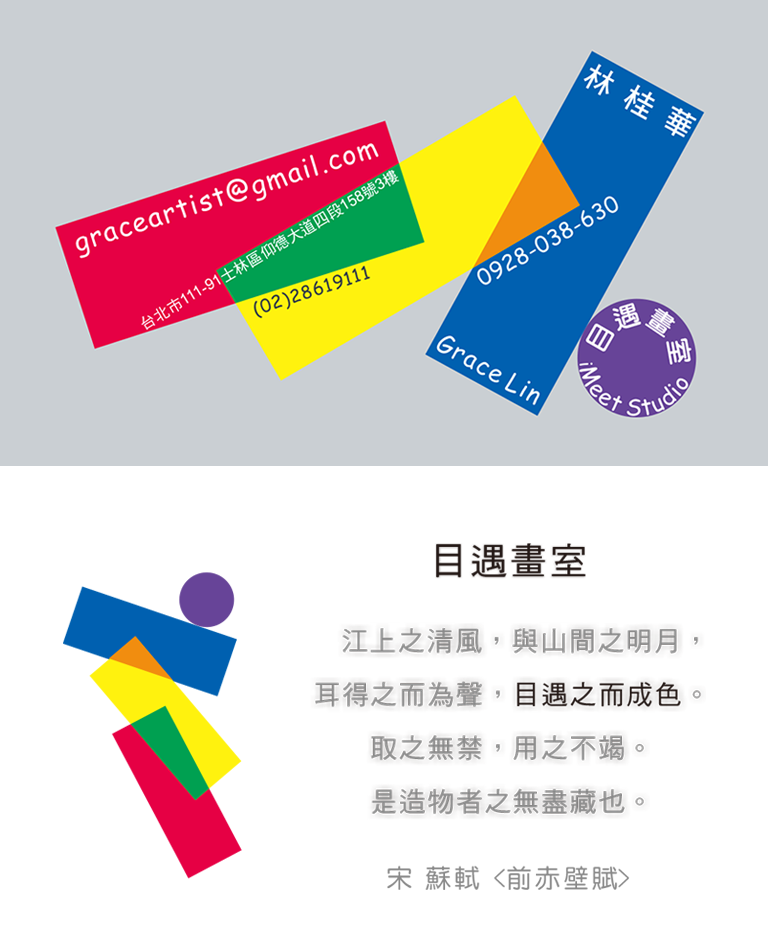
It began with a namecard.
In a sunny afternoon, I was invited to visit Ms. Kuei Hua Lin, the artist of “iMeet Studio.” On the back of her namecard, I saw that she quoted First Visit to the Red Cliff, a poem by Su Shi, the famous poet of the Song Dynasty poet: “Only the cool breeze on the river and the bright moon over the hills serve as music to our ears and color to our eyes, which we can take freely and enjoy forever; these are inexhaustible treasures supplied by the Creator, and things in which we can delight together.” She particularly put the sentence “color to our eyes” in bold, which clearly illustrated the origin of the name “iMeet Studio.” On the front side, Ms. Kuei Hua Lin overlapped three rectangles in three primary colors (red, blue, yellow) and put small circles in secondary colors such as orange, green, and purple in the overlapped area. The design not only shown her realization of “how to make the right color when you really need it” after reading Michael Wilcox’s book Blue and Yellow don’t make Green, but also revealed her definite ideal to fully interpret Nature with colors. Indeed, Ms. Kuei Hua Lin’s inspiration always came from the “infinite” nature, while the bright colors in her paintings glorified the beauty, the myth, and the life of the Universe.
It was not a straight road, and it was not accidental.
Ms. Kuei Hua Lin is not an academically trained artist. She has experienced many twists and turns throughout her artistic practice. However, it was definitely not an accident for her to enter the world of art. She has always been interested in painting since she was a child, and all her siblings are good at it. When she studied in the Department of Home Economics at National Taiwan Normal University (NTNU), she often had a chance to go to the exhibitions presented by the Department of Fine Arts. It thus evoked her curiosity and longing for the world of painting. After graduating from NTNU in 1975, she started her teaching career, went to the USA for advanced studies, started to work, fell in love with somebody, got married, and became a mother. Not until her children were grown up and her husband’s business was established could she really put down her domestic burden, being fully devoted to painting.
Her husband’s newly established firm required her to travel between Taiwan and the USA frequently. Therefore, she always took her off-work time to study with artists such as Mark Stickland, John Paul Thornton, Anny Kwon at Pasadena Center of Fine Art and Art Center College of Design-Pasadena in California, where she fundamentally consolidated her drawing skill. Her painting thus shows how she was academically influenced but without any academic burden of the conservative styles. She frankly shares with us that “I have tried every technique I can to express my unique feeling; once I master some technique, I will liberate myself from the conventional style to freely express myself.” When it comes to painting, she has a very clear mind and an interim goal to explore. She will never confine herself to an unchangeable dead end.
Line.Infinite
Wassily Kandinsky (1866-1944), the founder of an artist group in Germany “Der Blaue Reiter” and a pioneer of Abstract Art, published the book Point et ligne par rapport à la surface in 1926. The book was the principle he taught at Staatliches Bauhaus, Germany as well as the artistic concept he followed. From the geometric aspect, Kandinsky believes that a “point” is where three invisible plains meet. Therefore, the size of it equals “zero,” which signifies “commencement,” “origine” – “origo” in Latin. From the aspect of spirituality, “le point mystique” means “secret maçonnique.” In other words, it is “le grand dans l’infinitésimal” – the “divinité,” the “infini,” the most powerful of the smallest signs. It is the element representing “origin,” “regeneration,” and “initiation.” (Wassily Kandinsky, Écrits complets-La synthèse des arts, Denoël-Gonthier, Paris, 1975, p.223.)
Kandinsky also believes that the materialization of the invisible geometric object (“point”) is determined by three material properties, including “la dimension,” “la forme,” and “la couleur.” What the three material properties experiences during the process “to accumulate points into a line” or “to accumulate lines into a plane” is not the “qualitative change” but the “quantitative change.” Therefore, Kandinsky is strongly convinced that “a point alone may be sufficient for the most complex expressions” (Kandinsky, op. cit. p.224: “que le point à lui seul peut suffire à des expressions les plus complexes”).
Ms. Kuei Hua Lin elaborates Kandinsky’s fundamental concept of point, line, and plane, and she further points out the infinity of “line”: “line is infinite.” As an artist who always thinks meticulously, she says with confidence that “line is a very crucial element for a successful painting for that it is mostly used to represent a new concept or to demonstrate a central idea. It is infinite and experimental, offering an ideal training to form an idea or a concept. Line is also the most economic index to represent a space as well as the major element to establish the relationship between paper’s surface and image. It can be used to analyze, and it can be used as a method to transform the abstract thinking into the visual form. There is nothing better than line when it comes to transforming the three dimensional world into the two dimensional form. We can even say that line has the best fun – everyone has definitely experienced the fun of free drawing!”
Ms. Kuei Hua Lin is aware of the infinite potentiality of line: “it can be used to sketch, it can be used for mechanical or architectural function, it can be lyrical, limited, aggressive, hand-written, calligraphic, suggestive, fantastic, and it can be many other things. It can visualize strength and speed. It can represent the tidy, the undisciplined, the beautiful, and the ugly. Artists seldom limit it to a particular form when using it.” Her statement demonstrates the foundation of her artistic practice, which attempts to establish an image “with line as the focus.”
Since line is accumulated by infinite points and the property of “point” will not experience any qualitative transformation, we can claim that line is infinite. Such a statement is logically correct and acceptable. According to her instinct, she divides line into two categories: “the controllable line” and “the out-of-control line.” “Humans are full of contradictions – ” she says, “in a controllable life, the stability and the lack of challenge make we humans to feel bored while the unknown future makes us feared. Therefore, some who are willing to tolerate the repetitive and unchangeable life style choose to stay in the comfort zone forever, while some try to liberate themselves from the preexisting frame to accept the unknown change, without feeling regret even when being frustrated. It seems that prosperity is comforting while frustration is painful. However, the wonderful thing is that the experience of suffering sublimates our souls, bringing us incomparable happiness.” She further explains it in plain term that “I use controllable line to depict the beauty of stability, but I am more interested in using the out-of-control line to stir the emotions. The combination of both creates the vivid beauty.” Such a categorization seems to be sentimental, but it indeed reflects the connection between art-making and “consciousness.” In most of the cases, artists are conscious when working on their works of art, so the lines they create are “controllable lines.” In some of the cases, however, they are engaged in certain subconscious or semi-conscious state, so the lines they paint are not consciously controlled by moral logic. They become the “out-of-control lines,” casual and unrestrained. No matter what kind of style she paints, both “the conscious line” and “unconscious line” will keep each other’s company in a most appropriate way: “I like to intertwine both kinds of lines, bringing a harmonious but yet vivid touch to the paintings.”
A Style without a Style
After experimenting with various kinds of “painting materials” and “non-painting materials,” Ms. Kuei Hua Lin has come to the realization that “technique” and “material” cannot be separate when painting. It is necessary to be familiar with each material’s unique quality if one wishes to adopt various expressive styles. Therefore, right now at this point of her artistic practice, it is not her major concern to pursue a style with a unified form and unified material. However, a “style” is an individual artist’s unique method one adopts to practice his/her art (J. P. Néraudau, Dictionnaire d’histoire de l’art, Quadrige/Presses Universitaires de France, p. 443.), the “style” without a style can still be regarded as a “style.” Furthermore, Ms. Kuei Hua Lin’s recent paintings are in a stage to pursue an image “with lines as its focus” as mentioned above, no matter it is between still life and still life, or between landscape and landscape, or between still life and landscape…; The styles are not unified, but each work all discusses how “lines” play a crucial role in the painting.
Michigan Lakeside (2006, Acrylic on canvas, 88 x 188 cm) is one of the examples. The painting with immediate fluency, harmonious colors, poetic atmosphere, and melodious beauty visualizes the magnificent and mythical nature in such a perfect way. According to Ms. Kuei Hua Lin, the origin of the painting could be dated back to the year of 2006, when she went to Chicago to visit her daughter who was pursuing the Ph.D degree in Neuroscience at Northwestern University. One day, she took a walk to the lakeside early in the morning. When sun rose, she saw the cloud approaching the lake surface above the vast, ocean-like Lake Michigan. The dawn light and the fresh air mingle with each other, deeply touching her heart. On her way home, she went directly to the shop, waiting there till the shop opened to buy some acrylic materials, paintbrushes, and canvas. When she got home, she removed all the furniture in her daughter’s tiny room and spread the canvas on the floor to paint, visualizing her excited emotions into a painting. The Romanticists painted the emotional ups-and-downs of Mother Nature, and the Symbolists materialized the poetry-like singing praise. Similarly, Ms. Kuei Hua Lin adopts various lines – the rising and the descending, the rapid and the slow-moving, the gathered and the spread – to accumulate points into lines and lines into planes in a powerful and unrestrained way.
Likewise, Ms. Kuei Hua Lin also follows the great German philosopher Immanuel Kant (1724~1804) who focuses on the sublime beauty of nature. She makes her greatest effort to capture the rushing current in Glacier (2010, oil on canvas, 162 x 130 cm) or the last ray of light coming before the darkness in Sunset at North Cape (2010, oil on canvas, 162 x 130 cm) with dark and cold colors. “Line” plays a decisive role in the work Glacier. It is the contour of the river and the rocks as well as their movements and textures. It is the color, the light, and the shadow. It is the gleaming reflection and the spray being visualized, while it is also the abstract energy and rhythm. It is a real objectwhile it is also a symbol. As for the cryptic Universe in the painting Sunset at North Cape, the alternate uses of blue and orange lines allows Ms. Kuei Hua Lin to represent both light and darkness as well as ephemerality and eternity.
Giant Bird of Paradise (2011, oil on canvas, 112 x145 cm) is a realistic work with symbolic style. From “the observation on nature” to “the simplification of nature” and further to “the purification of nature,” Ms. Kuei Hua Lin’s artistic practice has been based on nature – “selon la nature” as how the great modern artist Paul Cézanne puts it. Meanwhile, her “symbolization” is not merely “according to nature” but also “according to the self of the artist.” There is no transition in the color gradation or brightness when painting the purified leaves. The only thing visualized is a clear comparison among separate colors and different degrees of brightness. Therefore, the colors are flat, pure, and balanced. The white bird-of-paradise appears to be particularly fresh in contrast with the purple flowers. Line indeed plays a precise and multiple role in this work for that it determines the contour of the leaves and the direction of the veins while it also represents the location and the depth of the light blue current. It is the ripples and the reflection. It is the flowing air and the melody for us to hear.
Best of Show (2006, watercolor on paper, 76 x 56 cm) is another painting with bird-of-paradise as its subject. Ms. Kuei Hua Lin seems to have mastered the property of the paint while working on this watercolor painting. When she puts the colors in layers, she takes the advantage of the time difference between the wet paint and the wet paint to create various effects such as color wash or different color-layers added. When she uses needle tube to inject thin lines of different colors, she particularly gains more control and creates unexpected effect of variations. The colors of the lines are decided by the need. The weeds around the bird-of-paradise are visualized with intertwined colors in citron yellow, orange, and green. Some of them are fragmented while some of them are continuous. Some of them move fast while some of them move slowly. They naturally materialize light-and-shadow of the weeds in a realistic but yet abstract way.
There is an anecdote about the extraordinary painting Wild Chrysanthemum (2005, watercolor on paper, 76 x 56 cm). One of Ms. Kuei Hua Lin’s college friends is very fond of photography. She often goes mountain trekking with her husband, takes beautiful photos, and uploads the photos on the internet to share with friends. One day, Ms. Kuei Hua Lin saw a photo of a beautiful wild chrysanthemum on the roadside, so she painted it into a half-sheet watercolor painting. Later, she heard that her friend had just moved to a new place, so she sent the framed painting as a gift. To Lin’s surprise, Lin’s friend told Lin that she also had a friend who had just moved and she sent the framed photo as a gift to her friend too. They looked at each other and started to laugh for that how they both thought of the same thing! However, the photographed wild chrysanthemum and the painted wild chrysanthemum indeed have different touches of beauty. Ms. Kuei Hua Lin’s Wild Chrysanthemum features an unrestrained spirit, perfectly balancing the thick, light, dried, and wet paints as well as the black spaces. The precisely depicted light yellow petals refuse to surrender, accompanied by the solid and firm pistils. Both of them are constructed by unbridled points and lines. Such a spirit which represents the tidiness with audacity is worth the praise.
There are two paintings with distinctive themes: Wind Brown Fabric Carp (2012, oil on canvas, 130 x162 cm) and Paper Blue Magpie (2012, oil on canvas, 162 x 130 cm). Ms. Kuei Hua Lin puts the fluttering “fabric carps” and “paper blue magpies” in the realistic scene, transforming the real world into a surrealistic dream in a blink. “A Wind Brown Fabric Carp is different from the usual landscape paintings,” she says, “for that I put a long line and a paper carp fluttering with the wind in the foreground. It is like that someone attaches a long rope to the window from inside the house, and the rope is also attached to a fabric carp fluttering with the wind, echoing the wind blowing far away in the maple woods with stark branches.” Indeed, a fabric carp in five colors (red, orange, yellow, green, and blue) is attached to a long line which is painted from the left to the right on the lower part of the painting. The colorful carp thus brings some “human touch” to the stark branches of the maple trees where no human being has been spotted. The realistic scene is transformed into the visualization of the artist’s “inner scene.” Ms. Kuei Hua Lin further talks about Paper Blue Magpies: “I use the same idea to paint the upper part of the central foreground. I paint several fabrics and put two paper blue magpies which are about to jump down attached to the fabric with two silk lines, as a comparison with the murmuring stream outside the window. One might even hear the resonance between the stream and the bird chirping.” At first, the fabric on the upper part of the painting shows the artist’s intention to transform the realistic scene of the stream into a world of fantasy. Especially when the two paper blue magpies tied with the silk lines are about to spread the wings and ready to soar, a primitive atmosphere full of magic rises up with the four white eyes of the blue magpies. These two paintings are like twin sisters in a surrealistic family, impressing us with their mélancolie and poetic touch. I am particularly fond of such a “mélancolie” feeling which can only be found in French literature or French art. These lines with various rhythms and directions are the key element to create a unified form.
Last but not least, I would like to talk about Ms. Kuei Hua Lin’s pastel paintings. Pastel is an ancient painting medium. It was first mentioned in the year of 1495 by the Italian artist Leonardo da Vinci (1452-1519). Later, Rosalba Carriera (1675-1757), the Italian artist from Venice, and the French artist Maurice Quentin de La Tour (1704-1788) both used pastel to create portraits which were as delicate, thick, and solid as oil paintings. In the 18th Century, Jean-Baptiste-Siméon Chardin (1699-1779), the Rococo artist in France, mixed pastel with opaque watercolor to create extraordinarily realistic figure portrait. In the 19h Century, the French Impressionist Edgar Degas (1834- 1917) started to use pastel since his eyes were seriously damaged by oil paint, and he thus created numerous pastel painting masterpieces with the trendy charm of fashion as his subjects such as milliners, opera houses, and ballet dance. The American painters Mary Stevenson Cassatt (1844-1926) and Leon Dabo (1868-1960) both mastered pastel painting too. The delicate rays of light catches our attention in Ms. Kuei Hua Lin’s Gift Basket (2009, pastel & oil on paper, 76 x 56 cm). The two paintings about orchids – Glimmer of Light (2012, pastel on paper, 76 x 56 cm), Orchids at Noon (2012, pastel on paper, 76 x 56 cm) feature the beautiful color-play between light and shadow while the hidden lines are only revealed in the glistening parts. The colors in Remembrance (2006, pastel on paper, 64 x 50 cm) refresh our souls with some lyrical and poetic touch. Mid-afternoon (2010, pastel on paper, 76 x 56 cm) creates a whisper between the contrasting colors inside and outside the window. The light-and-shadow is particularly delicate on the red tablecloth with white pattern, bringing all the tea set and the “Yunnan Seven Tea Cake” back to life. All the mentioned above prove her exquisite skill in pastel painting. If she can create more variations when mixing the different colors of the pastel paints, she will definitely reach a new level of pastel painting.
Conclusion
Although it is Ms. Kuei Hua Lin’s first solo exhibition and it still takes time to sort out her personal style, Ms. Lin’s concept and phased direction are explicit and definite. Her “confidence and sincerity” are particularly impressive: “I have always believed that as long as I have strong interest, observation ability, diligence, courage to try something new, and persistence, I can find my own path! Besides, it takes no language to paint, so I should give it a try at any cost!” It is the right spirit for a professional artist. Based on her words, I reexamine her works. Indeed, she has made it! However, I have higher expectation on her because her talent is full of potentiality. Hopefully, she will further enrich the lines’ interactive relationship with “planes” and “points,” creating more variations in color gradation. I am definitely looking forward to her next exhibition!
A Spiritual Song “iMeet” – A Writing about Kuei Hua Lin’s First Solo Exhibition
Written by Kuang-Yi, Chen╱ Ph.D in Contemporary Art History at Université Paris X Nanterre.Chairperson and Director of Department of Fine Arts at National Taiwan Normal University
Kuei Hua’s is an unpretentious artist who always mentions that she is not academically trained. For her, painting is the mixture of curiosity, dream, and a series of amazing accidents, which ultimately leads her to a life with a painting studio many professional painters long for and a great amount of outstanding works – without even knowing how and when. Now, she is organizing the very first solo exhibition in her life. It is indeed a legend for someone who graduated from the Department of Home Economics at National Taiwan Normal University (NTNU), who has admitted the lack of talent in art since childhood, who has worked as a middle school teacher for two years, who has studied nutritional science in the United States of America but never finished the degree, who has stepped into the business world for financial concerns, and who has diligently worked for almost thirty years to help fulfill her husband’s dream. How should we define such a painter? Is she an artist? How should we view her works? With what standard should we examine them? When we try to answer these questions, each definition of “professional artists” comes to our minds one by one, with which we carefully evaluate her artistic talent, her professional career, her artistic practice, and her works of art. Then, we come up with even more questions.
However, perhaps we should put down such a thread of thought about whether she is or she is not an artist, and return to a more fundamental question : why does Kuei Hua want to make art? Why did she walk into the painting class at the community school in Pasadena when she was 42 years old? Why did she decide to become a “freelance artist” when she moved back to Taiwan in 2007? Why being a “Sunday artist” no longer satisfy her ? Why does she continuously study more and more art theories, know more and more artists’ works, spend even more time on art, and devote stronger passion to her artistic exploration? How comes her leisure recreation become the life pursuit of a full-time artist? What is her spiritual support which attributes to the unique quality of her artworks when she marches toward the world of “professional artists?”
Art and Existence
It is a basic assumption in the art-making studies that human beings are motivated by the desire to create “form,” or the “significant form” as how Clive Bell (1881- 1964) puts it. Such a desire also evokes the interest in other people’s creative works. It is a common behavior shared by all humans, totally independent from any art education and cultural background. In fact, everyone can work on one’s creativity. The freedom of art-making exists among the anonymous public as well as professional artists. It is just because the Western art history narrative has been constructed by academies, museums, and governmental exhibition institutions since Renaissance, the artworks outside this system are all removed from it. Until Modernism prevailed in the whole world in the late 19th Century, artists started to pay attention to these artworks. Jean Dubuffet (1901-1985), who advocated “L’art brut” instead of “the art in the museum,” was one of the examples. According to his definition, “L’art brut” signifies that:
Various products (such as drawing, painting, knitting, kneading, or sculpture) represent spontaneity and extraordinary creativity,
which have nothing to do with artistic conventions or cultural cliché and are created by people outside the art society.
Concepts similar to “L’art brut” questions the essence of art: should we define art as a formal product as well as a final result of the practice of certain medium such as painting or sculpture, or should we define it as an attitude of self-reference one adopts when facing the world? Should we consider an artwork a complete aesthetic project or an experimental object with representational function?
Vincent Willem van Gogh (1853-1890), the artist whom Kuei Hua admires the most, did not officially have any academic training either. Record shows that he registered in the Académie royale des Beaux-Arts de Bruxelles and had studied there for three months. Later, he studied in a painting studio owned by Anton Rudolf Mauve (1838-1888), an artist from The Hague for a short time. The preparation process of his artistic career was totally dependent on his self-taught experiences and the influences from other artists. When he was 27 years old, he was fully determined to devote his life to painting. The strong passion for art-making inspired him to create 840 oil paintings, more than 1000 drawings, and numerous prints and watercolor paintings within merely ten years (1880-1890). Meanwhile, he had written hundreds of letters to his friends and family members to talk about his ideas about art and art-making, sharing his valuable thoughts. Without the burden collectively shared by the academically trained artist, van Gogh’s artworks are full of primitive energy expressed by his unique strokes. The dynamic visualizion directly hits us, touching the depth of our hearts.
For a person like Kuei Hua who is irrevocably determined to devote herself to art, one should have the same passion. Kuei Hua has once mentioned that her love for art is so deep that she feels pleased even when merely looking at an easel at the corner. Therefore, the first time she saw an easel advertisement in the magazine American Artist, she spent no time to hesitate and purchased one in her living room to look at it everyday. This episode in her life was eleborated into “a series of explorations of easels, paints, paper, brushes, palette knives, solvents and etc., while the process indeed brought her happiness and fulfillment!” Kuei Hua is deeply attracted to materials. Like an alchemist, she carefully examines the color paints, and manipulates the material changes of the medium she uses. She makes the best use of the materials and the tools to observe the existing objects, to express the reality, and to pursue the slimation of one’s own soul. Her watercolor paintings feature layers of wash, blank spaces, wipe-wash, and overlapping. She even bottles the mixed paints and uses needle tube to pump, to mix colors, to inject, and to splash on her paintings. The techniques created by herself function between the rational arrangement and the sensitive improvisation, or one can say, between the meticulous thinking and the intuitive impulse. Apart from the traditional oil paintings, she is also fond of non-traditional materials such as house paints or acrylic paints, with which she combines the delicate slow-painting and the fast needle-tube-splash, a technique invented by herself. Her pastel paintings, on the other hands, are eleborate and exquisite. She particularly likes using short and rapid strokes to render with the flow of the contours. Take Fruits for example, the strokes are spread over the whole image, creating a dominating network intertwined with fine and delicate lines. Light Surrounds Orchid is another example, in which the expressive strokes remind us of van Gogh’s late stage during his stay in Saint Rémy. All these mentioned above prove Kuei Hua’s significant affection toward Matière (material).
In an 18th-Century painting dictionary, Claude-Henri Watelet (1718-1786) has mentioned that “once the strokes are slightly excessive, they will become a symbol instead of an exact imitation.” Therefore, when painting removes itself from the function of imitation, the strokes coming from the reality become the “purpose” of painting. The 17th-century artist Rembrandt Harmenszoon van Rijn (1606-1669) was one of the pioneers to emphasize strokes, followed by Jean Antoine Watteau (1684-1721), Eugène Delacroix (1798-1863), the impressionnisme, and the matiéristes in the 1950s, who mixed different objects with color paints to create pâte with more thickness as a response to the issues of time, space, visuality, and tactility. Meanwhile, they also emphasized the material properties of painting as well as the man-made manipulation. According to the representative artist Jean Dubuffet, “the birth of art comes from materials and tools, so the trace of how art has been struggling with tools and materials should be reserved.” When materials are sufficiently manifested as the symbolic signs in the reality, they are empowered to evoke emotions and feelings, transforming the materiality of painting into the spirituality. When Existentialism prevailed over the post-war world, Jean Dubuffet considered art a creative process. Through the “traces” left by artists, viewers were allowed to reconstruct the creative process and to create a resonance with the existence of artists. When the art critic Harold Rosenberg (1906-1978) saw Jackson Pollock (1912-1956) painting – spreading the large canvas on the floor, walking around it or stepping onto the canvas, holding the brushes or sticks to freely splash the aluminum paint, creating breathtaking and suffocating twines of lines with traces marked by artist’s physical movements –, Harold Rosenberg could not help but gasping in admiration that “what’s on the canvas is an event rather than an image!” The meaning of painting shows how artists play their roles, for that they “devote all their emotions and wisdom to it.” The final painting thus embodies the existence of the artist.
Kuei Hua might not be a matiériste. What she has lived through is also different from the post-war artists. However, her passion for art and addiction to materials encourage her to explore a unique way playing with strokes, lines, or traces. The emotions visualized in her painting weight more than the calm and sober nature of academic art. Her art shows no purpose but the proof of the artist’s existence.
iMeet
Although Kuei Hua has lots of fun when experimenting with materials, she never intends to give up the imitative nature of painting to jump into the venture of abstract art. She is always fond of simple subjects, while most of them capture the daily scenes touching her heart, including the gift bascket sent by a friend, potted flowers, scenes from the studio window, and the magically created nature. She names her studio “iMeet Studio”, emphasizing the importance of visuality in her works.
However, artists’ work is not as easy as painting whatever they see. According to phenomenology, Nature might be a material existence which occupies certain space-time, while it is only revealed to people through human consciousness. Artists always have a unique perspective to see the world. As how Jean-Paul Sartre (1905-1980) puts it, the “intention” of artists constructs the images and makes up what the awareness lacks of. Even when artists are working with their “intuition,” their consciousness is not completely black-out. All the knowledge they own will be immediately poured down onto the image at one second. The different between an artist and an ordinary person is that an artist materializes one’s consciousness into a work of art once one realizes the world through the consciousness. During this process, artists’ physical bodies play a very important role, especially their eyes. Maurice Merleau-Ponty (1908-1961) has once explained that “Artists’ visuality is not merely an external gaze, a simple physical relationship between the eyes and the world – world is not revealed in front of an artist through representation” for that “the spirit and the thought will be seen and read from the gaze.” He believes that our eyes see everything, including the real and the imagined: “eyes fulfill those non-spiritual things which open up the spirituality.
Therefore, when painters are painting, their bodies serve as the bridge between the spirit of the painters and Nature. They open up themselves to the world. Painters’ action is not determined by the spirit alone. Instead, “it is the natural extension and maturation of visuality.” In other words, painters need to work on the thoughts and the emotions evoked by Nature rather than painting on the basis of nothing. Spirituality is not what you paint with. It is necessary to experience the process from the eyes, to the heart, and finally to the hand. It proves that painting is nothing like an exact representation of the reality while it cannot be separate from the reality either. Painting is the mixture of objects and spirits, as how Maurice Merleau-Ponty puts it “no matter whether it is realistic or not, lines are neither the imitation of objects nor the objects themselves.”
In his old age, Paul Cézanne (1839-1906) had lived a secluded life in Aix en Provence from 1885 till 1906, the year he passed away. During that period of time, he had repeated the same subject to paint at least 80 Mont Sainte-Victoire. In a letter to his son before his death, he wrote: “on the riverbank where I paint, I keep elaborating the subject. If we observe the same object from various perspectives, we will be able to demonstrate an even more powerful image. The variations are so rich that I guess I can stay here to paint for several months without changing my position.” Why was Cézanne so addicted to Mont Sainte-Victoire that he could even paint a thousand paintings about it without changing the place to paint? Obviously, when Cézanne was painting, what he intended to capture was not a visual representation of Mont Sainte-Victoire, or he would get bored easily. His explanation to a young fellow Joachim Gasquet (1879-1821) has indeed enlightened us:
These magnificent classic sceneries, our Provence, the land of Greece and Italy in our dreams, the landscape with the spiritualized light of brightness, the places where landscape becomes a smile of the clever wisdom… look at Mont Sainte-Victoire. It is so unrestrained, with such a strong and outrageous eagerness for the sunlight. When it gets to the night time, all the burdens are released, creating a sense of sadness…these rocks are made of fire, and there is still fire inside. Both the shadow and the sunlight seem to be afraid of them, so they step back, shivering. When the thick and heavy cloud comes, the shadow fallen on the rocks is shivering too as it were burned and vaporized by the fire… for a long while, I have not known how to paint Mont Sainte-Victoire.
The story helps us to understand that Mont Sainte-Victoire was more than a mountain to Cézanne. It was the spiritualized landscape. When the painter again and again returned to Mont Sainte-Victoire alone, with the attempt to surmount the “previous” Mont Sainte-Victoire and to visualize the greatness of the mountain in his perception in an even more perfect way, he thus meditated in silence alone in front of the mountain. He “listened with his eyes,” as how the poet Paul Claudel (1868-1955) describes it. Both his spirit and mind were slowly immersed in the landscape which seemed always the same but made him fail to turn his gaze away. They exchanged spirits, and that was the moment when Cézanne finished one painting after another. In a letter to Emile Bernard (1868-1941) in 1905, Cézanne finally claimed that “time and thinking gradually change the way we see, and now it is the age of comprehension.”
Kuei Hua also mentions a lot how she feels in front of Nature. It is this feeling which has driven her to reeperience it through painting and to solve the mystery of the heart. When she came to Chicago to visit her daughter who studied at Northwestern University, she used to take a walk to the lakeside. One day at dawn, she saw “that the Sun rose up above Lake Michigan and the cloud was so low that it almost touched the lake surface above the vast, ocean-like lake. The dawn light and the fresh air mingled with each other, deeply touching my
heart. I suddenly felt a strong impulse to capture this moment on my way home.” Therefore, she bought the painting materials right away, finishing the painting Michigan Lakeside on the floor of her daughter’s living room in two days. Her Sunset at North Cape and Glacier are
twosimilar works. Another habit of Lin is “to sit beside the window to observe the scenery.” Therefore, she is particularly interested in painting potted flowers in backlight and the elongated shadow. She can keep painting the same subjects without feeling bored. Orchids are one of her favorite subjects, while six paintings of orchids will be shown in this exhibition. Among them, the two pastel paintings Glimmer of Light and Orchids at Noon share almost the same composition with slight difference in light-and-shadow. She also paints a large oil painting Orchids on the Glass Table with the same composition too, but she never bores us with tedium repetition. Such a repetitive depiction with persistence perfectly demonstrates the harmonization of the world and the self. For Kuei Hua, painting indeed is the combination of the world and the spirituality.
As a female artist
In the end, I would like to talk about Kuei Hua as a “female artist” – the identity one cannot ignore and how it is related to her passion for art.
Growing up in a big family with more than one hundred family members, Kuei Hua recalls that “as long as you don’t cry and stay quiet, no one will pay any attention to you, and no one will think of you. It’s better for you to stay at the corner without getting others’ way.” Therefore, she soon got used to “forgetting her own existence.” Moreover, her family lived on her father’s slender earnings, so she had learned “to avoid unnecessary expenses and to spend as little money as possible until graduating from college.” After college, she had been teaching for two years but still resigned from her teaching job to fulfill her dream – studying abroad. Soon, she quit school because of her financial concerns and started to make a living in the business world. It was during this time that she got married. The primary concern in her life became her husband’s dream and her children. Even when she was ill, she still “forgot her own existence.”
We might all be familiar with such a story. The contemporary feminists believe that the oppression of women comes from a patriarchal society, where all men as a whole are empowered with authority over women. As for Marxists, they tend blame it on capitalism, accusing it for the capitalization of labor. Some even mix the two theories, arguing that the oppression of women results from the collision between the patriarchal society and capitalism. No matter what it is, it is for sure that women are the disadvantaged minority in most of the society. They need to search for spiritual freedom, an exit to let go what they have been through, in the harsh reality. Art, which offers an illusion opposite to the reality, thus plays an indispensable role in the reality, particularly to women. In Ien Ang’s research, she writes about women’s pleasure and desire:
Illusion and fiction will not replace the dimension of life (including social practice, morality, political concept, and etc.) but live with it. It… is the resource of sensation for that it highlights the “reality.” In the world of illusion and fiction, the real-life anxiety and the intertwined oppression become plain and straight-forward. It is how “text” constructs an imaginative solution to the realistic social conflict.
Growing up in a traditional patriarchal society in early Taiwan, Kuei Hua seldom questioned her own destiny. Like other women at that time, she always accepted everything happening to her, quietly playing her role and submissively surrendering to the reality. It was not an ignorant sacrifice. She did not need those feminists to analyze by whom she was oppressed. I sincerely believe that it was her virtue urging her to take the responsibility for her parents, for her family, for the society, and for herself. Indeed, even though it was Kuei Hua’s choice to consider responsibility her primary concern, it did not mean that she had to be trapped by the reality. Art has offered her a path of escape – the Utopia for her self-fulfillment and to reconstruct her own identification. Therefore, painting was particularly important to Kuei Hua. She captures the beautiful flowers, magnificent landscape, tranquil woods, and the rustic countryside with colors and lines. She creates a spiritual Utopia, a safe house for herself, where she has found pleasure and satisfaction. Stepping out of the world of “forgetting her own existence, ” she finally fulfills her existence.
Right before Kuei Hua’s first solo exhibition, I am writing this article for this unusual friend, a passionate artist who has always pursued the harmony between the world and herself, and a women in search of her self-fulfillment. Kuei Hua should know better than anyone else that it is just a beginning. I sincerely wish that she will go on with unceasing passion to climb her Mont Sainte-Victoire.
Painterly Superimposition: Solo Exhibition of Kuei-Hua Lin
Written by Jian Liting
The drastic variation of human’s visual experiences caused by development of technology and changing lifestyle often influences the artistic expression we create. Consequently, artistic practice – or “the freedom of expression” as how we usually define it – celebrates not only the individual’s inner reaction but also the interrelation among one’s cultural experience, artistic context, the materiality of media, and the life journey of an individual. Similarly, the effects of three different visual experiences can be discovered in Kuei-Hua Lin’s works: first of all, the context of “painterliness” in the tradition of painting; secondly, the camera angle in photography; thirdly, the dislocation of printing or superimposition in the image-base art history.
To begin with, “painterliness” is a term commonly used in art history, opposite to the concept of linearity. Art historian Heinrich Wölfflin (1864-1945) has characterized the artistic transformation from Renaissance to Baroque as change of style from linearity to painterliness. According to him, linearity describes the clear and flat linear design popular in Renaissance art, while painterliness allow Baroque art to create a three-dimensional quality with curves, obscure contours, and a stronger chiaroscuro effect. The contrast somewhat summarizes the spectrum of Western art – the former is more classical and restrained while the latter is more emotional and expressive. In this respect, Lin”s art is close to the painterely concept. In her artmaking, she not only freedom of painting executed by her hand. Therefore, most of her previous works feature a greater spontaneity thanks to the flowing lines and dripping =effect of water-based pigments.
The second visual experience is related to photography. Her favorite composition is either an upward view or a close-up, a result of her habit of modeling photos of flora which she has taken in her journey. In fact, the increasing accessibility to photography has make it a tool in painting, but the real impact on the practice of painting is in its cultural and visual aspect that photography provides a new camera-based perspective beyond the traditional composition in painting. As a result, it is no longer required for painting to establish a well-developed storytelling scene but encourages it to focus on the fragmented, partial, instant, photographic image. Meanwhile, the detailed, close-up partial view further highlights the quality of painting as a form.
The third visual experience comes from the dislocation of printing and superimposition. Nowadays, we may feel familiar with these kinds of effects caused by printing errors, chromatic errors, photographic multiple exposure of intentional superimposition. Whether intentional or by mistake, the effects reveal the thin, flat, and accumulative quality of image itself. Examples can be found in the artmaking process of Lin’s recent works where she chooses various images of silhouette and makes them into several shaping plates, while she later applies layers of thick or thin acrylic paints on them. The direction of the strokes and shapes is often intersecting the shaping plate’s composition, crating three layers of images, including the one painted with the plate covering, with it half covering, and with it removes. The artmaking process reflects the thin-versus-thick relation between images and paints. With an intentional emphasis on its e=texture, it highlights a relief-like thickness variation between the part with plate covering and part without.
Lin’s artistic practice is inspired by her life. Simple subjects are her favorite, while the overall scene depiction in her earlier works is gradually replaced by partial views of flowers and fruits. Similar to Paul Cezanne (1839-1906)’s dedication to still life painting and Mont Sainte-Victoire, Lin also adopts simple scenes and objects to elaborate her exploration of shapes. Through the layers and artmaking procedure of her works, such as the techniques of emboss, fretwork, brushing, and reserving the background, we are invited into a dialogue between the layered painting and image itself.