

Destructive rebuild: Break through the Past
In the past of human history, occasionally appearing people with multiple talents, for example, Leonardo da Vinci. Although an illegitimate child, never accepted formal education, but excelled in painting, math, architecture, music and astronomy, etc. and had tremendous achievement. Michaël Borremans from Belgium, a photographer at first, became an outstanding contemporary artist. A. Savage, a musician and a visual art creator, connected and related vision and hearing to create various works in forms (music and painting) to record his life. Jeff Koons, once a stock trader in Wall Street, continuing his creation after work and finally becoming the most important Pop Artist after Andy Warhol. Academic artists have solid practice and ability on basics of creation, but they often are unable to discard the academic burden. On the other hand, non-academic artists, although without formal and timely learning process, they excel in various territories and sometimes have outstanding and astonishing performance.
History has come into the blooming years of Contemporary art. The variety of form, material and theme are no longer fresh and avant-garde. Every artist pursues to think out of the box and surpass the past. Studied in Art Center College of Design, Pasadena, Lin moved to California, US because of health issue, but restarted her dreams of becoming an artist during her stay in California where there is always sunlight. After years of creation and exhibitions, she found her unique style of creation.
Change in Theme
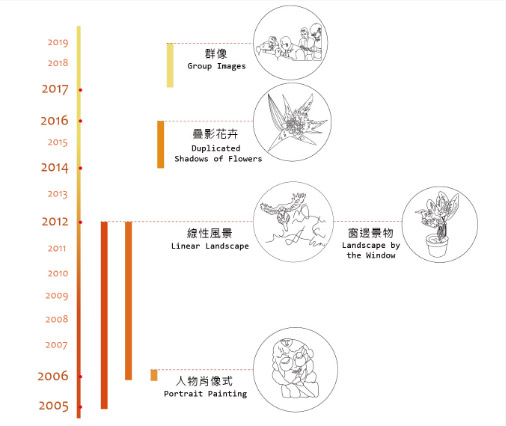
Lin’s path of creation has been inspired by figure sketch. She studied the traits of Impressionism, capturing the natural landscape, emphasizing on light and colors. She untraditionally uses smooth and flowing lines to portray nature. Next, she starts to pay attention on the still objects and landscape from windows, such as flowers, trees, still objects next to a window. Then she begins to focus on the interaction between people. When the modern electronic devices interfere with people’s interaction, she transforms from the concept of window and frame to monitors of electronic devices. The artist started from God giving light, colors and natural landscape to reach architecture created by humans through realistic windows. The human souls enter the virtual world of technology through the monitor of a mobile phone. In the past 12 years, you can see the following categories of Lin’s works: figure (portrait), linear landscape, still objects by the window, duplicated flowers, group image. From 2006 to 2019, the themes for creation varied in great range. Through the observation of creation method, it is surprising to find such deep learning in forms and techniques. In this series of figures, it is obvious to see the artist has completed her own unique creation style.
Destructive rebuild: Break through the Past
Creation to Lin is a self-breakthrough. Through rigorous work structure and professional studio equipment, it is not difficult to understand that she looks at creation as work, not some romantic or random sparkles. She sets goals and plans to execute. As a concept of creation, she finds usable material in daily photographic records. First, she uses computer for preparation, and records her ideas and thoughts. Once she starts with the composition phrase, she structure what is in her mind with simple lines and choose the base colors with instinct. As for technique, she uses traditional paintbrush and palette knives as well as roller, silk screen printing, template, embossment, syringe, dipping, duplication, transparant and intransparate techniques…etc. The actual painting process is in two parts: formal representation and destructive rebuild. In other words, she proceeds with the second part of creation on the existing painting sketch with tearing templates, usage of frames, applcation of imagery windows, extension of lines, change in colors, process of multi-layer paints, image matting, technique of thick and thin, …etc. to make the images unconventional. Even when it’s the same theme and composition, she still applies different methods. The artist is persistent towards this creation for the purpose of breaking through the old method of creation and unexpected new effect. Therefore, she continutes to break through.
Exploring the Tech Generation : Alternations in Human Behaviors
In the always changing generation, Lin, originally a tech person, acutely observes how electronic devices change human behaviors. She discovers that there are always three groups of people in family gatherings, social events and friends gathering: husbands who discuss about work and use the mobile phones, wives who chat and sing and use the mobile phone, and children who play and use the mobile phones. Mobile phones serve different demands and social functions in different generations, roles, and groups. Electronic devices such as mobile phones, tablets and computers penetrate people’s social group, making people in one place able to contact with people in another place. This is an example of loose relationship. Mobile immersion is the new topic in recent years, referring that people in crowded subway or parties wanting to escape from the current location but since they are bound to the place they could only escape to the world of the monitor of mobile phone to find their comfortable zone. Lin, however, thinks differently. She thinks that the business manager in the parties in her paintings are thinking everyday what is beneficial for people, so they work hard with mobile phones to handle the business. She admires these people’s attitude towards work, therefore records the conception with her painting brush.
Composition of Decomposition
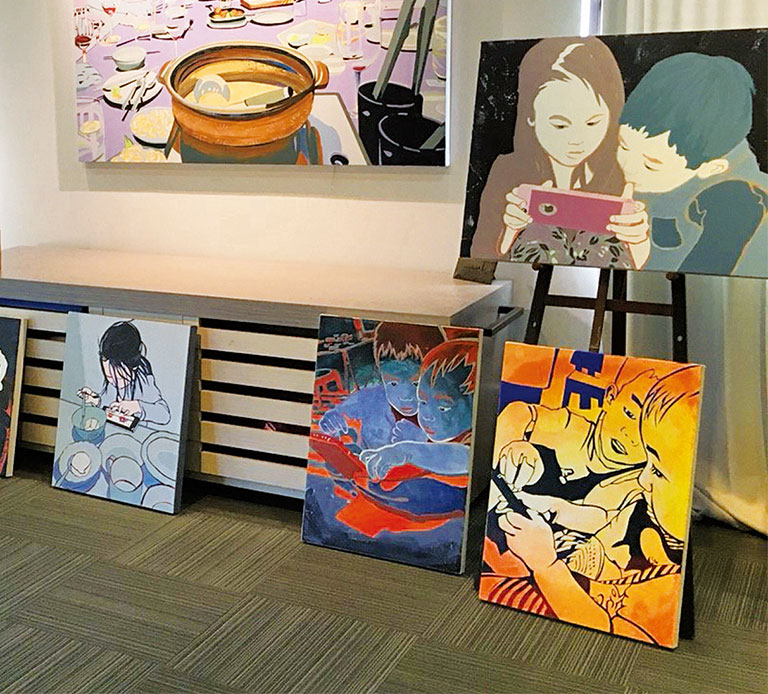
In Lin’s works, Focus , One and Only, Roaming, Excited, etc., the figures in the paintings are repeatedly duplicated with solely white color. We can only observe the outline of figures to understand their characters and ages. It looks like the people in the daily life photos interacting with each other. Through decomposing to omit facial features and emotions, the audience can freely imagine and input different facial features and emotions with the remaining line of the face. This technique reminds audience of their previous family lives. Sometimes, the artist would use subjective colors to separate and lower the critical point of colors. She also contrasts and matches colors. to differentiate gradual layer of paint point, she uses plain and pattern style to define different objects and spaces with color blocks. In the works, Joining the Party, ChoiceI、II, Business First, What are You Doing?…etc., she mixes the colors on roller of silk screen printing to intentional interfere with the layers of space. The bright colors give the audience a refreshing experience. Lin chooses this method because of the change brought by the electronic devices. First of all, electronic devices make communication break through time and territory, echoing the interference of untraditional transparent space. Secondly, the colored roller lowers the depth of the view. For example, when we look at the monitor with everything flat, we can change the color of the screen to make it different from reality, similar with adjusting the display color of the screen. Many special effects intertwine on the image to produce visionary beauty, echoing the purpose of looking at the window on the monitor.
Cloud Gallery presents Kuei-Hua Lin’s sole exhibition, including works from these past three years:“Embracing the Future”,“Virtual Reality”,“ Young Minds”and “Sincerity ”.
“Embracing the Future”- describes children facing technical products since their childhood.
“ Virtual Reality”- as the main theme, extending various social perspectives “ Young Minds”- the most innocent child as the main character. Through children’s curiosity and interest, we go back to a state of no worries. “Sincerity ”- Portray the characters surrounding the artist through portrait painting to narrate the artist’s emotional connection in daily life.
Welcome everyone to see this wonderful exhibition.
Abserving Addiction – Kuei-Hua Lin’s Family Album
Written by Kuang-Yi Chen╱Professor, National Taiwan University of Art. Principal, Fine Art College
With tremendous energy and creativity, Kuei-Hua Lin always uses various materials and boldly attempts different methods without academic burden. In her exhibition in 2016, the series of huge and dazzling flowers express liveliness and unique technique and style. Although the flower series was unforgettable, Lin gave up flowers and landscape in her later creation. Without hesitation, she changed to figures painting.
Lin’s figure painting also comes from daily life, mainly about family, relatives, friends, especially family gathering and ordinary life. Le Portrait de famille, description of family and their lives, originated from the La Grande Bourgeoisie during the 19th centry Industrial Revolution. Comparing with the noble rank or priests, La Grande Bourgeoisie lack context of iconology from the past therefore change to praise values of family; they attempted to leave the image of their success in society and economy. During this period of time, photography was not popular yet. Family portraits are popular and play an important part in the modern paintings. Edgar Degas’s painting of his aunt and uncle , the“Bellelli” (1858-1867) was the most famous example. The painting consists great amount of details. It looks simple but it took Degas several years to finish. It always expresses his skill and cleverness in observing family relations. This painting also became his expression of realism and also showed the taste, style and attitude of the Bourgeois.
When photography becomes popular, with the transition of digitalized photograph, so called “ post-photo ”, family portraits have been replaced with family photos. It is no longer the Bourgeois’ possession. Family photos capture the very ordinary daily life activities. Family photo, in the contemporary images, stands a certain position. It not only valued by genealogists for building and filing family history data, it also is loved by contemporary artists, writers, photographers, screenwriters and movie lovers in 1960. People keep probing these private pictures, trying to dig out hidden stories behind the photos. Lin’s new works are obviously based on the family photos. Although she expresses it in paintings, the composition and framing are full of the touch of photography. It is interesting how reproducing the ordinary family photos in the expression of paintings can produce such refreshing result.
However, family photo is not that dull and ordinary in photography. Its ordinariness is also its uniqueness. Taking a family photo is to capture an important moment in family life(New Year, ceremony, vacation, etc.) and to keep it in the memories of the family members. Therefore, the figures postures, emotions, identification, the happening of incidents, etc. are better than the skill and presentation of photography. As photo capturer is usually not a professional, the unskillfulness becomes the trait and format of family photos. In other words, the will and choice of content of the capturer serves far more better than methodology. Moreover, family photo is not only an essential tool to explore the daily lives, it also serves as meaningful and unique images. When choosing the topic, the capturer especially loves the beautiful and joyful moments to beautify family’s common memory. These images bear the weigh of love and relations. Sometimes they are passed around within the family, individually sharing the private memory. Sometimes they are general, appropriate for everyone who holds similar memories and imaginations towards family. When they see other people’s family picture, they are also touched. Finally, people tend to systematically collect family pictures and arrange them in time, incident or other methods to create their own family album. Some artists prefer to use family photo album to structure and lay out their images. They choose and rearrange the images in their or other’s family photo album to “remise en scène”.
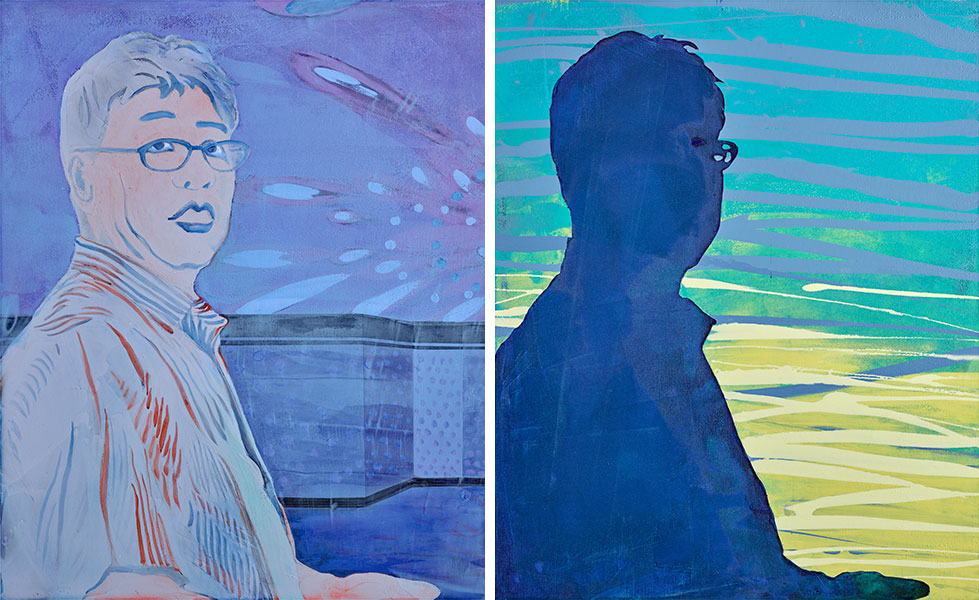
We can imagine Lin’s creation is also like this. She has a collection of family photo album, hers or collected. With the artist’s keen and wise sense, she chooses, connects and converts into paintings. Next, she arrange the works into a family photo album through exhibitions to start a story or description. Lin’s conversion of image to paintings is gorgeous. She prefers dazzling bright colors, but sometimes she uses silent and steady midtones. She likes linear framing and Silhouette-like thin and flat form. Sometimes she describes the portrait-ness and dimensionality. Sometimes the colors she uses follow the forms and shapes, but sometimes the jump out of the form and wildly spread on the canvas. Her colors are wildly spreading and dipping, some of them even protruding on the canvas like an embossment. However, sometimes her colors converge and hide, loyally serve the representation of paintings.
Such dynamic and complex techniques bluntly reemphasize its identity as a painting, hiding and balancing the origin of the used photo. She inadvertently cuts and captures reality like photo frames in the layout. As for the layout of figures and scenes, she purposefully emphasize the repetition, for example, “ Choice One”. “Choice Two” “Find One” “Find Two”, different method of copying of the same picture. She also prefers repetition of trivial difference in figure poses and different angles, such as the four pieces of works , “Enlightenment One” to “Enlightenment Four”, or the change in children’s poses “Wandering”and “Excited”, like continuous shooting. Moreover, the zoom in and zoom out of lens, such as “The Best Choice”is probably the close up of “Time Tunnel”, etc. These works all express their imagery, from family to portraits to the original family photos.
With these family photos, what kind of family album does Lin want to show us?
First of all, she is not in any of these pictures, implying she is an observer, narrator, photographer, collector or a portrait artist. Figures in the photos are mostly children, narrating a long history of the family. In the 19th century, only children with in a certain high ranking could be allowed in the photos. Nowadays, children have become the main figures in family photos. Nevertheless, when we look at these photos closely, it is surprising to see how they sharply reflect the current society. Intentionally or not, all of these works remind us of the existence of electronic devices such as cell phones, tablets, computers …etc. There is tremendous amount of screens appearing in the paintings. We can reasonably assume that these works originated from family photos taken by cell phones. Indeed, nowadays, taking family photos has become one of the main functions of cell phones. In 2007, when the first iPhone came out, Steve Jobs said, “Revolutionary product will change the world!” His prophecy has come try after 12 years. The world has been changed completely. According to the survey made by National Development Council in 2016, for people over 12 years old, three out of four people are cell phone holders. The time people spend online in one day is 3 hours and 21 minutes. There are 61% of people who eat and slide their cell phones when dining with their families and friends, 80% of people are waiting for a ride or in a ride, and 81% before they go to bed. Additions to electronics, computer/mobile games, cell nomophobia (fear of no cell phone), have become trendy vocabulary. We, as the slaves of cell phones, staring at the phone screens every now and then, checking social media every couple of minutes, replying and sharing instantly, have a hard time breathing. In Lin’s family photo album, seniors and children are constantly looking at the phone screens, sometimes alone, sometimes in a group watching videos or playing games. And the other family members indulge in the virtual world of mobile phones. Sometimes, they would take pictures of food tasting or karaoke. And next, of course, they would upload and check in on social media, back to phones. Wonderful moments such as gathering, eating and singing together stay in the family’s memory forever. However, the intentionally highlighted and flattened figures in photos lose their identification, like an emptied hold or a missing silhouette due to loss of memory.
What is Lin expressing through a family photo album like this?
I do not think she is simply criticizing the worried social phenomenon of additions to electronics. I am also not sure if she feels different, lost, or sorry that family is different today compared to the past. Her perspective is not quite clear. Especially when the identification of these family portraits are faded by her painting techniques, there is no evidence showing these photos originally belong to whom, to which particular family and their story. Just like Susan Sontag said,“ No matter whom is photographed, photos will convert to reality. The images of objects or incidents can be beautiful or scary, or unbearable, or tolerant even if they are not in reality.”With the interference of arrangement of images and the painting method, Lin presented a series of paintings that rely on the audience memory and imagination. However, no matter how realistically the audience can imagine, it is still someone else to them, therefore, they are still in the position of bystanders. Although in “ Regarding the Pain of Others”, Sontag refers to a more serious topic, the imagination family photo albums provide to the audience might be further than we can imagine.
These experience are very much like Christian Boltanski’s works. He rearranged the family photo album of one of his friends in 1971 and created“Album de photos de la famille D”. People thought they could find out the history of this family, however, Boltanski wrote,“ For the past 25 years of family life, we didn’t find anything. These images of family ceremonies send us to our own memories. In a percicular society, all family photo album share the simiar traits. They cannot reproduce reality, they only prsent the reality of the phto album.”As the function of family photo album alter as the society changes, especially in the post modern society, they tangle with history, society and politics files and become unclear, swinging in between virtuality and reality. Therefore, once family photos detach the original function and become anyonume, losing their referentinality, legality, date or a relevant name, they are left as reflective sumbols and memories. Lin’s every family portrait converted from family photo implies the passing of time, the change of the society, the conncection of history and the us at this very moment. I do not know why, but it reminds me of Rchard Hamilton’s famious work, “Just what is it that makes today’s homes so different, so appealing?”, in 1956.
Virtual from the Window : Kuei-Hua Lin’s Solo Exhibition
Written by Li-Ting Jian╱Lecturer, Taipei National University of the Arts
From Painting to Window of Imagery
Although there are various methods and rich materials in the artistic creation nowadays, Renaissance theorist Leon Battista Alberti’s ”Window”, still deeply influences our visionary experience. In his De Pictura created in 1435, he talked about the origin of painting,”First of all about where I draw. I inscribe a quadrangle of right angles, as large as I wish, which is considered to be an open window through which I see what I want to paint.”In this virtual window, what Alberti sees apparently not the landscape outside, but historia, a space that does not belong in reality, a descriptive scene. This explains the main topic of the painting was not the window, but use it as a metaphor, insert abstract theory into the prospective, mimic, understand and learn human’s noble behavior through vision, as an inspiration of humanity.
When paintings bear the content of religion, history, saints and historic incidents, they convert from simply describing reality to some kind of delicately planned narrative. The object and space painted as a stage, the imagery is the scene or the actors in it. It is not surprising to think this allegory also works with monitor. Scholar Anne Friedberg’s work is directly named“The Virtual Window : From Alberti to Microsoft”extending the“Window”from Renaissance to the digital times. In the past, looking at paintings is probably like us looking at mobile phones, computers or TV. No matter from the technical prospective or cognitional habit, rectangle frame might be the best imagery scope.
The connection of“Alberti’s Window”with the past and modern times reflect the history of human imagery experience. This can be understood as the clue of Lin’s current creation. Her work never leaves out digital devices, converting
into paintings in various methods through photography. On the other hand, her current work turns to the people surrounded, especially focusing on the people’s behavior when using mobile phones and tablets. Monitors everywhere have been a common phenomenon. It has become our new path to know the world, from the method of cognition to the content.
Therefore, we present“Re-Visiting Virtual Window”as the topic of Lin’s sole exhibition, expressing the paintings, the frames, and the topic. Exhibited works include two topics: before 2017, which is mainly using plants, flowers as themes, such as Kite, Flowing Light and Commencement , etc… These works use acrylic , templates and syringe, to let the paint naturally cumulate, duplicate and cover on canvas, producing rich layers of paints. Another topic is after 2017, mainly focusing on people. However, instead of portrait paintings, she locates the figures in particular scenery, especially the people who are using mobile phones and tablets, with extending techniques. These works involve the following prospective:
The Angle of Photography and the Language of Painting
Lin’s works have obvious photographic angle. This has to do with her material obtained from cameras. In her earlier works which focused on plants, you can see close-ups of various plants. A corner in the flower bushes, for example, or the end of a branch, these is never a complete scene in the imagery, no horizon nor linear prospective for space structure. In the current works, the photographic materials are acquired from daily lives, mostly indoor. The figures in paintings usually concentrate on staring at mobile phones and tablets, other than that, there is no other arrangement of narrative or imagery structure. Therefore, there is always incomplete and pieces of shape or object in Lin’s works, incomplete, unlike the stage setting. They are pretended three dimensional elements compressed in a two dimensional frame. The complete timeline in classical narrative is shuttered into pieces of life. This concept of shuttered time is influenced by the modern society. The“Modernism”in 1863, as Charles Baudelaire said,“ the ephemeral, the fugitive, the contingent”would appear to be stronger in the 21 century with the data explosion and internet.
Although through the assistance of photography, we still cannot neglect Lin’s execution on painting method. She focuses on the shaping for forming of painting. For example, she uses a great amount of templates, acrylic paints layering. Peeling templates and showing the covered base color. Or spaying, dipping, flowing and pressing paints to form natural thickness. These all show the random and out-of-control signs of the artist in visionary. She often uses the same picture or pictures taken in seconds to make symmetric paintings. In similar imageries, she experiences different portrayals. If we chase back to the two traditions of western paintings, sketches and colors, instead of the emphasis on reason, linear and structure in former, Lin’s obviously chooses the latter, sensible, painterly and effective. The successors of the Color style in modern art also provide Lin’s reference on paintings. Although her works are not abstract, she expands methods through painting particular objects.
From Medium to Life of Image
Besides acquiring scenes from photography, medium of digital image and other cultural events have also become Lin’s concerned topics. It has to do with her past working with computers and mobile phones, as well as her way of pioneering on artistic creation. In fact, history has never lacked retro stylists, whether it’s resisting industry and yearning for the nature, or doubting the civilization and pursuing the innocence and purity of gardens and farms. They develop relative artistic works. On the contrary, another group of artists are passionate about the current environment and insert the passion in their works. For example, Philip James de Loutherbourg’s painting on furnace in factories, J. M. Turner’s painting on battleships and steam trains in the 19th century. These are not simply an alternation of topics, but also signify the possibility of experiencing new perspective and the representation and extension of this new perspective in term of artistic language.
Same as before, when Lin starts to turn her topic to people’s life with electronic devices, she faces the limitation of angle. Plants in natural are dynamic in the physical space, like you have to look up to see the tree branches; however, people’s life environment becomes simpler. The photographic angle also becomes ordinary. In the sense of psychological cognition, compared with dynamic appearance of plants, humans are more recognizable in shape. Therefore, the audience tend to directly distinguish the people from the painting itself. In Classics, historical painting, portrait paintings are difficult. If the expression figures ́ postures and emotions has to be precise without beauty, then the portrayal of people in modern art is different but in a way opposite of the Classics. Because compared with other materials, human shape is full of limits. Artists have to work hard to compress the human form under the artistic language, through human unlikeness to achieve the effective of work. For example, The Fauves and the Expressionist artists place figures in strong lines and color blocks. George Baselitz even paints figures upside down to achieve an indistinguishable, abstract effect.
Therefore, when Lin uses photographic angle to describe ordinary daily life, she emphasizes on the thickness of the material and mix it with templates and imprint technique. Next, like Focus , Enlightenment 1-4 , Is It Time Yet? , Lin conspicuously borrow American comics and color separation in printing to arrange figures from bright to dark as well as the complication of frames to form different blocks to make templates. That is why the figures in paintings have acute lines. She also uses multi-layer duplication technique and emphasizes the paints with overflowing linear blocks of colors, such as Business First , Deal , Photographer . These practices lead the painting language to the digital life constructed by mobile phones and tablets.
Genre Painting in 21st Century
Lin’s method of scene acquisition from photography and her passion on digital life cause her to pay attention to the relationship between family and friends and take photos of them. This brings a perspective of“witness”to her works. People in paintings are usually concentrating on monitors, neglecting the surrounding. These so called“phubber”undoubtedly is unneglectable in contemporary cultural phenomenon. And the charisma of monitors comes from the development of communication. If we use year 2000 as the countries are open for the third generation of third generation of wireless mobile telecommunications technology as the time point, the“phubber” is considered the product of the 21st century.
Back to the“Window”allegory, if the Renaissance painting is classic, theory pursuing, nature surpassing virtual window, then the painting themes which system of classicism depreciating would lead to rich and dynamic virtual window, Lin’s works present remarkable life style of today. It might be called some kind of genre painting in the 21st century, composed by the contemporary life intertwined with painting, photography, and monitor and what’s behind the scene.
